

The SIC Core specification is a free standard that defines a set of harmonized simulation meta data attributes that meta-data standards can adopt to avoid ambiguity and incompatibility in common attributes across domains and standards. It is currently being developed as a joint undertaking of IRT SystemX and prostep ivip.
As such it is currently not normative, nor is this document to be considered officially endorsed by any of the involved organizations prior to its official adoption.
Releases and issues can be found on GitHub.
Copyright © 2022-2026 IRT SystemX and 2022-2026 prostep ivip.
1. Introduction
1.1. Motivation
Simulation-based engineering has become an essential component of modern product development. Simulation models are increasingly exchanged between organizations and engineering domains in order to support design decisions, verification activities, and system validation.
The MIC Core Standard provides a standardized approach for describing metadata of simulation models. It enables consistent identification, management, and exchange of simulation models across organizations.
However, simulation models are rarely used in isolation. In engineering practice they are typically applied within simulation tasks that follow a structured engineering workflow. These simulation tasks are initiated by simulation requests, use simulation models and other resources, and produce results that support engineering decisions.
In complex development environments, especially in large organizations and cross-company collaborations, the traceability and understanding of simulation activities becomes critical. It must be possible to answer questions such as:
-
Which engineering question was addressed by a simulation?
-
Which models and parameters were used?
-
Which simulation environment and tools were applied?
-
Which quality criteria were defined and verified?
-
Were the simulation objectives and credibility requirements fulfilled?
While the MIC Core specification provides metadata for simulation models, it does not support and describe the simulation tasks in which those models are used (see figure 1).
This specification addresses this gap.
Decision Task
      |
      v
Simulation Request
      |
      v
Simulation Task
      |
      v
Simulation Models (MIC Core Metadata)
      |
      v
Simulation Results

Simulation Results --> Search
Simulation Results --> Analysis
Simulation Results --> Reuse
1.2. Purpose of SIC Core
The purpose of SIC Core is to introduce a standardized semantic structure for metadata describing simulation tasks and simulation requests.
The SIC Core specification enables:
-
improved understanding of simulation activities
-
support for search, analysis, and reuse of simulation tasks
-
documentation of simulation processes
-
improved collaboration across engineering teams and organizations
The SIC Core specification defines harmonized metadata attributes describing simulation tasks along the phases of a simulation engineering process.
The attributes defined in this specification provide a common semantic basis for describing simulation tasks. However, the specific selection of attributes that are required in a given environment is application-specific and may depend on organizational needs, engineering processes, and use cases.
1.3. Relation to MIC Core
This document is an adjunct specification to the MIC Core specification.
The principles and guidelines described in the introduction of the MIC Core specification also apply to this specification.
The specification does not modify the existing MIC Core model metadata definitions. Instead, it complements them by introducing metadata describing the context in which simulation models are used.
Simulation tasks reference simulation models defined according to the MIC Core specification.
The definition of metadata attributes in this document follows the same methodological principles as MIC Core, including
-
structured attribute descriptions,
-
classification of attributes by obligation level,
-
support for extensibility, and
-
clear semantic definitions.
The goal of this specification is therefore not to prescribe a fixed metadata implementation, but to define a consistent semantic framework that can be adopted and extended by organizations.
1.4. Simulation Process Context
The metadata structure defined in this specification follows a simulation process aligned with the Credible Simulation Process Framework, as defined in [CSP], as referenced in the SSP Layered Standard Traceability 1.0.0 specification (see [SSPLST]):
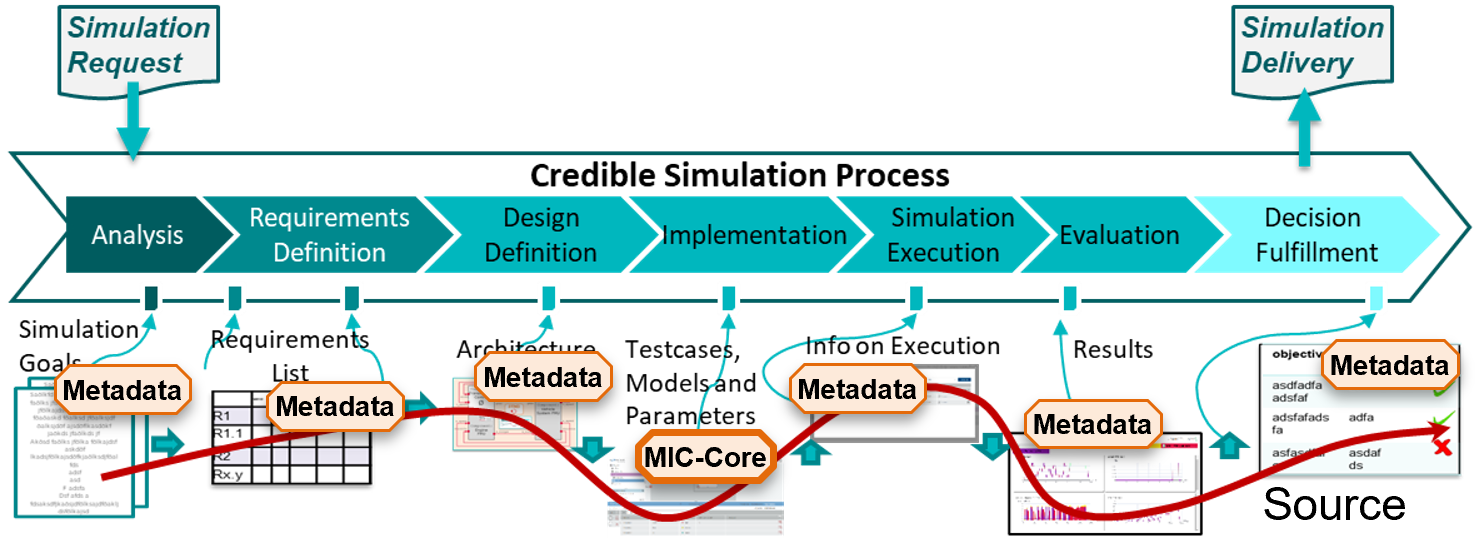
This process distinguishes the following phases:
-
Analysis
-
Requirements
-
Design Specification
-
Implementation
-
Execution
-
Evaluation
-
Fulfillment
Each phase contains specific metadata attributes that describe the state and context of the simulation task within the engineering workflow. This process-oriented structure supports traceability across the complete lifecycle of a simulation task.
Additionally, there are attributes that describe administrative data about the simulation task, which are not specific to any particular phase but are essential for identification and organization.
1.5. Properties and Guiding Ideas
A key objective of this specification is the standardization of metadata semantics, not the restriction of possible metadata structures.
This means that the standard defines
-
which metadata concepts exist,
-
how they are semantically defined, and
-
how they relate to each other.
At the same time, organizations remain free to
-
extend the attribute set,
-
introduce additional attributes, and
-
integrate company-specific metadata structures,
as long as the defined semantics remain consistent.
This approach allows organizations to implement the standard incrementally and according to their specific engineering processes.
Additionally, the specification is designed to be technology-agnostic, meaning that it does not prescribe specific data formats or technologies for metadata representation, or mapping of metadata items to specific attribute names in a specific format.
1.6. Sub-Attributes
For a number of attributes, for example for Simulation Task, the specification allows the use of sub-attributes to describe the attribute in more detail, e.g. by providing both machine-readable and human-readable variants of a name, version information, or URIs.
The use of sub-attributes is per-se optional, however standards implementing this specification can make the use of sub-attributes, and the use of certain sub-attributes mandatory.
The list of allowed sub-attributes is listed in the definition of an attribute. Since they are shared between attribute definitions, the definition of common sub-attributes is placed in Section 2.9.
1.7. Obligation Levels and Use-Case Dependency
The attributes defined in this specification are categorized into three obligation levels: Mandatory, Recommended, and Optional.
-
Attributes are mandatory, if they are essential to support the defined basic use cases or functionalities
-
Attributes are recommended, if the information is in general of high importance for consistent documentation and extended analysis of simulation activities
-
Attributes are optional, if they are important in organization-specific or advanced use cases
Mandatory attributes represent the minimum set of metadata required to support basic use cases and functionalities, such as:
-
search for simulation tasks
-
analysis of simulation activities
-
identification of reusable simulation setups
-
understanding of the simulation context
However, the specific traceability, analysis, or documentation requirements of an organization are typically use-case dependent.
Therefore, implementations of this standard should evaluate which additional metadata attributes are required for their specific environment.
The classifications recommended and optional allow organizations to extend the metadata set according to their needs without losing semantic consistency.
1.8. Versioning
This specification uses semantic version numbers, as defined in [PW13], where the standard version consists of a triple of version numbers, consisting of major version, minor version, and patch version numbers.
In the context of SIC Core, major versions can add, delete or change attribute definitions, minor versions can only add or clarify attribute definitions, and patch versions can only clarify attribute definitions.
1.9. How to Apply this Standard
This specification is directed at authors of meta-data and meta-data format standards. It is intended that standards that want to adopt the SIC Core set of attributes shall do so by claiming conformance as specified in section Section 3. This involves the adoption of the attribute definitions of the SIC Core under the rules set down in section Section 3.
End users of these standards will look towards the standards for the full specifications of all attributes, whether adopted from SIC Core or not.
1.10. How to Read This Document
Conventions used in this document:
-
Non-normative text is given in square brackets in italic font: [Especially examples are defined in this style.]
-
The key words "MUST", "MUST NOT", "REQUIRED", "SHALL", "SHALL NOT", "SHOULD", "SHOULD NOT", "RECOMMENDED", "MAY", and "OPTIONAL" in this document are to be interpreted as described in [RFC2119] (regardless of formatting and capitalization).
2. SIC Core Attributes
This chapter introduces and describes the list of SIC core attributes. Each attribute is introduced with an attribute description and an indication of the attribute obligation, i.e., whether the attribute is mandatory, recommended, or optional, and whether the attribute can be instantiated multiple times or not. To enhance the understanding of an attribute, some value examples and, if applicable, additional explanations or rationales for the attribute are provided.
In Appendix B a subset of the full set of SIC Core attributes is defined that enables basic functionality for search, analysis, reuse, and traceability. This subset of metadata can also be used as starting point in the implementation of metadata for simulation.
The attributes of SIC Core are organized by the following attribute groups:
-
Administrative Data
-
Analysis
-
Requirements
-
Design
-
Implementation
-
Execution
-
Evaluation
-
Fulfillment
2.1. Administrative Data
The Administrative Data category contains information used to identify and organize the simulation.
2.1.1. Overall Product
The Overall Product is the overall product within the company’s project management IT infrastructure, whose development or validation requires the respective simulation.
- Obligation
-
Recommended
- Can have multiple values
-
Yes
- Sub-attributes
- Value entry examples
-
-
carZZ, aeroplaneTT
-
- Additional explanation and rationale
-
Providing the Overall Product attribute makes it easier to track and trace the impact of a simulation result on the overall product for which the simulation is initially being requested and executed. "Overall product" can also refer to a customer’s product if a company develops and simulates a relevant product as a system or component specifically for a customer product.
2.1.2. Specific Product
- Attribute description
-
The Specific Product is the specific product within the company’s project management IT infrastructure, whose development or validation requires the respective simulation.
- Obligation
-
Recommended
- Can have multiple values
-
Yes
- Sub-attributes
- Value entry examples
-
-
AD-34basic
-
- Additional explanation and rationale
-
Providing the Specific Product attribute makes it easier to track and trace the impact of a simulation result on the specific product for which the simulation is initially being requested.
2.1.3. Ordering Project
- Attribute description
-
The Ordering Project is the ordering development project within the company’s project management IT infrastructure.
- Obligation
-
Recommended
- Can have multiple values
-
No
- Sub-attributes
- Value entry examples
-
-
cam34basic
-
- Additional explanation and rationale
-
Providing the Ordering Project attribute makes it easier to track and trace the simulation task and the simulation request back to the ordering development project and its engineering context.
2.1.4. Simulation Request
- Attribute description
-
The Simulation Request is the simulation request within the company’s project management IT infrastructure.
- Obligation
-
Recommended
- Can have multiple values
-
No
- Sub-attributes
- Value entry examples
- Additional explanation and rationale
-
Providing the Simulation Request attribute makes it easier to trace back to the simulation request when it is referenced in a simulation task or simulation delivery, for example.
2.1.5. Simulation Task
- Attribute description
-
The Simulation Task is the simulation task within the originating company’s project management IT infrastructure.
- Obligation
-
Mandatory
- Can have multiple values
-
No
- Sub-attributes
- Value entry examples
- Additional explanation and rationale
-
Providing the Simulation Task attribute makes it easier to trace back to the simulation task when it is referenced in a simulation delivery.
2.1.6. Simulation Task Confidentiality Level
- Attribute description
-
The Simulation Task Confidentiality Level is a classification with respect to the access to contained information.
- Obligation
-
Recommended
- Can have multiple values
-
No
- Value entry examples
-
-
CSC-0: public
-
CSC-1: internal
-
CSC-2: confidential
-
CSC-3: strictly confidential
-
- Additional explanation and rationale
-
The Simulation Task Confidentiality Level attribute uses a classification system that specifies how confidential the information contained in the classified document is to be treated. Typically, there is a set of rules that specifies what may and may not be done with a document and the information it contains.
2.1.7. Predicted Simulation Start Date
- Attribute description
-
The Predicted Simulation Start Date is the date at which all information will have been provided so that the simulation service can start.
- Obligation
-
Recommended
- Can have multiple values
-
No
- Value entry examples
- Additional explanation and rationale
-
The Predicted Simulation Start Date is meaningful information for the simulation engineers for simulation process planning and team workload planning.
2.1.8. Requested Simulation Delivery Date
- Attribute description
-
The Requested Simulation Delivery Date is the due date that the simulation results will be appreciated by the ordering person or organization.
- Obligation
-
Recommended
- Can have multiple values
-
No
- Value entry examples
- Additional explanation and rationale
-
Providing a Requested Simulation Delivery Date attribute helps plan the details of a simulation process depending on available organizational and technical resources and the expected process duration.
2.1.9. Requesting Person
- Attribute description
-
The Requesting Person is the person who needs the obtained simulation results on a technical level and will work with the results.
- Obligation
-
Recommended
- Can have multiple values
-
Yes
- Value entry examples
- Additional explanation and rationale
-
Providing the Requesting Person attribute in combination with the Contracting Person attribute helps streamline communication in the event of questions about the details of the request or a need for technical clarification. Which Requesting Person’s information is actually provided depends on negotiations and regulations.
2.1.10. Requesting Entity
- Attribute description
-
The Requesting Entity is the department or external company that needs the obtained simulation results on a technical level and will work with the results.
- Obligation
-
Recommended
- Can have multiple values
-
Yes
- Value entry examples
- Additional explanation and rationale
-
Providing the Requesting Entity attribute in combination with the Contracting Entity attribute helps streamline communication in the event of questions about the details of the request or a need for technical clarification. What information about the Requesting Entity’s information is actually provided depends on negotiations and regulations.
2.1.11. Contracting Person
- Attribute description
-
The Contracting Person is the person who accepts the simulation request to provide a simulation service.
- Obligation
-
Recommended
- Can have multiple values
-
No
- Value entry examples
- Additional explanation and rationale
-
Providing the Contracting Person attribute, in combination with the Requesting Person attribute helps streamline communication in the event of administrative questions about the details of the request or a need for administrative clarification. Which Contracting Person’s information is actually provided depends on negotiations and regulations.
2.1.12. Contracting Entity
- Attribute description
-
The Contracting Entity is the department or external company who accepts the simulation request to provide a simulation service.
- Obligation
-
Recommended
- Can have multiple values
-
No
- Value entry examples
- Additional explanation and rationale
-
Providing the Contracting Entity attribute in combination with the Requesting Entity attribute helps streamline communication in the event of questions about the details of the request or a need for technical clarification. What information about the Contracting Entity’s information is actually provided depends on negotiations and regulations.
2.1.13. Simulation Task Creator Name
- Attribute description
-
The Simulation Task Creator Name is the name or other regulatory-compliant valid identifier of the person who initially created the simulation task in the project management IT system.
- Obligation
-
Optional
- Can have multiple values
-
No
- Value entry examples
- Additional explanation and rationale
-
The Simulation Task Creator Name attribute should automatically be extracted from the project management IT system.
2.1.14. Simulation Task Creation Date
- Attribute description
-
The Simulation Task Creation Date is the date the simulation request in the project management IT system was created.
- Obligation
-
Optional
- Can have multiple values
-
No
- Value entry examples
- Additional explanation and rationale
-
The Simulation Task Creation Date attribute should automatically be extracted from the project management IT system.
2.2. Analysis
2.2.1. Item under Test
- Attribute description
-
The Item under Test specifies the product, system, component, or software, etc. that is subject of a simulation being requested by a simulation request or performed by a simulation task.
- Obligation
-
Mandatory
- Can have multiple values
-
No
- Sub-attributes
- Value entry examples
-
-
camera34
-
camera34-A-sampleV23
-
- Additional explanation and rationale
-
Providing the Item under Test attribute helps clarifying the subject of simulation.
2.2.2. Higher-level Engineering Task
- Attribute description
-
The Higher-level Engineering Task is a higher-level engineering task that sets the context of the specific engineering task.
- Obligation
-
Recommended
- Can have multiple values
-
No
- Sub-attributes
- Value entry examples
-
-
Development of an AD driving function based on camera signals
-
- Additional explanation and rationale
-
The Higher-level Engineering Task attribute in combination with the Specific Engineering Task attribute supports understanding the context in witch the simulation is placed.
2.2.3. Specific Engineering Task
- Attribute description
-
The Specific Engineering Task is the engineering task that directly benefits from the simulation results.
- Obligation
-
Recommended
- Can have multiple values
-
No
- Sub-attributes
- Value entry examples
-
-
Detection of critical occlusions when turning right with pedestrians.
-
- Additional explanation and rationale
-
The Specific Engineering Task attribute in combination with the Higher-level Engineering Task attribute supports understanding the context in witch the simulation is placed.
2.2.4. Simulation Objective
- Attribute description
-
The Simulation Objective represents the engineering question that is to be answered by the simulation task.
- Obligation
-
Mandatory
- Can have multiple values
-
Yes
- Value entry examples
-
-
assessment of the camera resolution by simulation
-
- Additional explanation and rationale
-
Providing the Simulation Objective attribute helps keep the focus on the target and to ensures that the entire simulation task is streamlined to the target.
2.2.5. Further Simulation Requirements
- Attribute description
-
The Further Simulation Requirements define what is to be determined, confirmed, or neglected by a simulation.
- Obligation
-
Recommended
- Can have multiple values
-
Yes
- Value entry examples
-
-
the distance between vehicle and pedestrian must be higher than 1.5m
-
- Additional explanation and rationale
-
Providing the Further Simulation Requirements attribute is an important input for the development of the test cases of a simulation. Often detailed information is linked.
2.2.6. Quality Criterion
- Attribute description
-
A Quality Criterion is a quality requirement that must be met during the simulation, particularly given the importance of the decision to be made.
- Obligation
-
Recommended
- Can have multiple values
-
Yes
- Value entry examples
-
-
companyZ simulation quality assessment
-
- Additional explanation and rationale
-
The Quality Criterion attribute facilitate the configuration of the simulation setup.
2.2.7. Verification Criterion
- Attribute description
-
A Verification Criterion is a quality requirement that must be met during the simulation in order to verify that the simulation results align with the specified objectives of the simulation task.
- Obligation
-
Recommended
- Can have multiple values
-
Yes
- Value entry examples
- Additional explanation and rationale
-
Providing the Verification Criterion attribute helps to align with the Specific Engineering Task and to facilitate the simulation setup by providing clear instructions.
2.2.8. Validation Criterion
- Attribute description
-
A Validation Criterion is a quality requirement that must be met during the simulation in order to validate that the simulation results align with the needs of the Specific Engineering Task that requested the simulation.
- Obligation
-
Recommended
- Can have multiple values
-
Yes
- Value entry examples
- Additional explanation and rationale
-
The Validation Criterion attribute helps to guarantee that the simulation objectives and targets align with the specific engineering requirements and to define the simulation setup.
2.2.9. Analysis Phase Verification Result
- Attribute description
-
The Analysis Phase Verification Result is the conclusion of the analysis phase closing verification.
- Obligation
-
Recommended
- Can have multiple values
-
No
- Value entry examples
- Additional explanation and rationale
-
The Analysis Phase Verification Result attribute serves to confirm that the analysis of the engineering task has been properly performed. This could be a link to a document.
2.3. Requirements
2.3.1. Model Purpose and Objectives
- Attribute description
-
The Model Purpose and Objectives are indicating, based on the simulation purpose and objectives, individual Model Purpose and Objectives.
- Obligation
-
Recommended
- Can have multiple values
-
Yes
- Value entry examples
-
-
specification of camera resolution for Automated driving function at object-list level
-
- Additional explanation and rationale
-
The Model Purpose and Objectives attribute, in alignment with the simulation purpose and objectives, facilitates the specification of individual simulation models and parameters.
2.3.2. Modeled Entity
- Attribute description
-
The Modeled Entity is the real-world entity that is to be modeled.
- Obligation
-
Recommended
- Can have multiple values
-
Yes
- Sub-attributes
- Value entry examples
-
-
camera34-A-sampleV23
-
- Additional explanation and rationale
-
Providing the Modeled Entity attribute enables specification of individual simulation models and parameters. This could not only comprise the item under test, but all additional entities modeled needed to conduct the simulation.
2.3.3. Required Modeled Effect
- Attribute description
-
The Required Modeled Effect is a real-world physical effect that is to be considered in the modeling.
- Obligation
-
Recommended
- Can have multiple values
-
Yes
- Value entry examples
-
-
resolution of camera
-
- Additional explanation and rationale
-
The Required Modeled Effect is a real-world physical effect that should be considered in modeling.
2.3.4. Further Model Requirements
- Attribute description
-
The Further Model Requirements is additional requirements placed on a model, including things that explicitly shall / are not be considered in the model.
- Obligation
-
Recommended
- Can have multiple values
-
Yes
- Value entry examples
- Additional explanation and rationale
-
The Further Model Requirements shall be considered in the same liability as the required modeled effects. This may not yet be available at the start of the simulation task. The attribute could therefore be omitted. It should be present once the simulation task has been completed.
2.3.5. Simulation Model Confidentiality Level
- Attribute description
-
The Simulation Model Confidentiality Level is a classification with respect to the access to classified information.
- Obligation
-
Recommended
- Can have multiple values
-
No
- Value entry examples
-
-
CSC-0: public
-
CSC-1: internal
-
CSC-2: confidential
-
CSC-3: strictly confidential
-
- Additional explanation and rationale
-
The Simulation Model Confidentiality Level attribute uses a classification system that specifies how confidential the information contained in the classified document is to be treated. Typically, there is a set of rules that specifies what may and may not be done with a document and the information it contains.
2.3.6. Model Quality Requirement
- Attribute description
-
A Model Quality Requirement is a requirement placed on a simulation model.
- Obligation
-
Optional
- Can have multiple values
-
Yes
- Value entry examples
- Additional explanation and rationale
-
Providing the Model Quality Requirement attribute helps specify the implementation of simulation models.
2.3.7. Entity Parameter
- Attribute description
-
The Entity Parameter reference provided parameters of the entity to be modeled.
- Obligation
-
Mandatory
- Can have multiple values
-
Yes
- Value entry examples
-
-
data sheet of camera
-
material database
-
- Additional explanation and rationale
-
Providing the Entity Parameter attribute is essential input information for the parameterization.
2.3.8. Value Distribution Function
- Attribute description
-
The Value Distribution Function (value deviation) specifies the probability of deviations certain value.
- Obligation
-
Recommended
- Can have multiple values
-
Yes
- Value entry examples
- Additional explanation and rationale
-
The Value Distribution Function attribute serves for ensuring that the simulation results are robust against little value deviation in a real world situation (required tolerances uncertainties).
2.3.9. Parameter Confidentiality Level
- Attribute description
-
The Parameter Confidentiality Level is a classification with respect to the access to classified information.
- Obligation
-
Recommended
- Can have multiple values
-
No
- Value entry examples
-
-
CSC-0: public
-
CSC-1: internal
-
CSC-2: confidential
-
CSC-3: strictly confidential
-
- Additional explanation and rationale
-
The Parameter Confidentiality Level attribute uses a classification system that specifies how confidential the information contained in the classified document is to be treated. Typically, there is a set of rules that specifies what may and may not be done with a document and the information it contains.
2.3.10. Parameter Quality Requirement
- Attribute description
-
A Parameter quality requirement is a requirement placed on (a set of) parameters.
- Obligation
-
Optional
- Can have multiple values
-
Yes
- Value entry examples
- Additional explanation and rationale
-
Providing the Parameter quality requirements in requieremts phase attribute helps specify the implentation of parameters. Quality requirements can be also part of general requirements
2.3.11. Test Case Requirements
- Attribute description
-
The Test Case Requirements is the description of the goals and objectives of a test case.
- Obligation
-
Recommended
- Can have multiple values
-
Yes
- Value entry examples
- Additional explanation and rationale
-
Providing the Test Case Requirements attribute helps specify the implementation of test cases.
2.3.12. Test Case Confidentiality Level
- Attribute description
-
The Test Case Confidentiality Level is a classification with respect to the access to classified information.
- Obligation
-
Recommended
- Can have multiple values
-
No
- Value entry examples
-
-
CSC-0: public
-
CSC-1: internal
-
CSC-2: confidential
-
CSC-3: strictly confidential
-
- Additional explanation and rationale
-
The Parameter Confidentiality Level attribute uses a classification system that specifies how confidential the information contained in the classified document is to be treated. Typically, there is a set of rules that specifies what may and may not be done with a document and the information it contains.
2.3.13. Test Case Quality Requirement
- Attribute description
-
A Test case quality requirement is a requirement that is placed on a test case.
- Obligation
-
Optional
- Can have multiple values
-
Yes
- Value entry examples
- Additional explanation and rationale
-
Providing the Test case requirements attribute helps specify the implementation of test cases. Quality requirements can be also part of general requirements
2.3.14. Simulation Environment Requirement
- Attribute description
-
A Simulation Environment Requirement is a requirement placed on the simulation environment.
- Obligation
-
Recommended
- Can have multiple values
-
Yes
- Value entry examples
-
-
tool for causal modeling and simulation and supporting FMI
-
FEM
-
- Additional explanation and rationale
-
Providing the Simulation Environment Requirement attribute helps specify the required simulation environment.
2.3.15. Simulation Environment Quality Requirement
- Attribute description
-
A Simulation environment quality requirement is a requirement placed on the simulation environment.
- Obligation
-
Optional
- Can have multiple values
-
Yes
- Value entry examples
- Additional explanation and rationale
-
Providing the Simulation environment quality requirement attribute helps specify the required simulation environment. Quality requirements can be also part of general requirements
2.3.16. Simulation Integration Requirement
- Attribute description
-
A Simulation Integration Requirement is a requirement placed on the interaction of the simulation setup elements.
- Obligation
-
Recommended
- Can have multiple values
-
Yes
- Value entry examples
- Additional explanation and rationale
-
Providing the Simulation Integration Requirement attribute helps specify the required simulation integration, i.e. to specify how all elements of the simulation setup should interact.
2.3.17. Simulation Integration Quality Requirement
- Attribute description
-
A Simulation integration quality requirement is a requirement that is placed on the simulation integration.
- Obligation
-
Optional
- Can have multiple values
-
Yes
- Value entry examples
- Additional explanation and rationale
-
Providing the Simulation integration quality requirement attribute helps specify the needed simulation integration, i.e., specify how all elements of the simulation setup shall interact. Quality requirements can be also part of general requirements
2.3.18. Quality Assurance Requirements
- Attribute description
-
A Quality Assurance Requirements is a requirements that is placed on the quality assurance in the requirements phase.
- Obligation
-
Recommended
- Can have multiple values
-
Yes
- Value entry examples
- Additional explanation and rationale
-
Providing the Quality Assurance Requirements attribute helps understand the quality assurance measures made in the requirements phase. The attribute contains the derivation or decomposition of the quality criteria specified in the objectives section.
2.3.19. Requirements Phase Verification Result
- Attribute description
-
The Requirements Verification Result is the result of the verification activity in the requirements phase.
- Obligation
-
Recommended
- Can have multiple values
-
No
- Value entry examples
- Additional explanation and rationale
-
Providing a Requirements Verification Result attribute helps recognize the quality status of the requirements phase results. This attribute can contain a link to a verification report.
2.4. Design
2.4.1. Model Design Specification
- Attribute description
-
A Model Design Specification is the definition of how models are to be implemented, including model approaches, interfaces model structure, etc.
- Obligation
-
Recommended
- Can have multiple values
-
Yes
- Value entry examples
- Additional explanation and rationale
-
The Model Design Specification attribute provides the base for the model implementation. Typically, the attribute contains a link to the appropriate document or the model name and version which should be used.
2.4.2. Model Design Quality Requirement
- Attribute description
-
A Model Quality Requirement is a requirement that is placed on a simulation model.
- Obligation
-
Optional
- Can have multiple values
-
Yes
- Value entry examples
- Additional explanation and rationale
-
Providing the Model Design Quality Requirement helps to implement simulation models with appropriate and sufficient quality.
2.4.3. Parameter Design Specification
- Attribute description
-
A Parameter Design Specification is the definition of how parameters are to be implemented, including parameter structures, names, values, tolerances, etc.
- Obligation
-
Recommended
- Can have multiple values
-
Yes
- Value entry examples
-
-
format test environment
-
links to data sheets, measurements, material data
-
specifications on handling tolerances uncertainties
-
- Additional explanation and rationale
-
The Parameter Design Specification attribute provides the base for the (set of) parameters implementation. Typically, the attribute contains a link to the appropriate document or the Parameter Name and version which should be used.
2.4.4. Parameter Design Quality Requirement
- Attribute description
-
A Parameter Design Quality Requirement is a requirement that is placed on (a set of) parameters.
- Obligation
-
Optional
- Can have multiple values
-
Yes
- Value entry examples
- Additional explanation and rationale
-
Providing the Parameter Design Quality Requirement attribute helps to implement the (set of) parameters with appropriate and sufficient quality.
2.4.5. Test Case Design Specification
- Attribute description
-
A Test Case Design Specification is the definition of how test cases are to be implemented.
- Obligation
-
Recommended
- Can have multiple values
-
Yes
- Value entry examples
-
-
formats
-
structure
-
clarification
-
- Additional explanation and rationale
-
The Test Case Design Specification are the base for test cases.
2.4.6. Test Case Design Quality Requirement
- Attribute description
-
A Test Case Design Quality Requirement is a requirement that is placed on a test cases.
- Obligation
-
Optional
- Can have multiple values
-
Yes
- Value entry examples
- Additional explanation and rationale
-
Providing the Test Case Design Quality Requirement helps to implement test cases with appropriate and sufficient quality.
2.4.7. Simulation Environment Design Specification
- Attribute description
-
A Simulation Environment Design Specification is the definition of how simulation environment is to be implemented or which tool and version should be used.
- Obligation
-
Recommended
- Can have multiple values
-
Yes
- Value entry examples
- Additional explanation and rationale
-
The Simulation Environment Design Specification attribute provides the base for the Simulation environment implementation. Typically the attribute contains a link to the appropriate document or the tool name and version which should be used.
2.4.8. Simulation Environment Design Quality Requirement
- Attribute description
-
A Simulation Environment Design Quality Requirement is a requirement that is placed on a simulation environment.
- Obligation
-
Optional
- Can have multiple values
-
Yes
- Value entry examples
- Additional explanation and rationale
-
Providing the Simulation Environment Design Quality Requirement attribute helps to implement the simulation environment with appropriate and sufficient quality or the chosen tool has to fulfill.
2.4.9. Simulation Integration Design Specification
- Attribute description
-
A Simulation Integration Design Specification is the definition of how simulation components are to be integrated.
- Obligation
-
Recommended
- Can have multiple values
-
No
- Value entry examples
- Additional explanation and rationale
-
The Simulation Integration Design Specification attribute provides the base for the Simulation integration implementation. Typically the attribute contains a link to the appropriate document.
2.4.10. Simulation Integration Design Quality Requirement
- Attribute description
-
A Simulation Integration Design Quality Requirement is a requirement that is placed on a simulation environment.
- Obligation
-
Optional
- Can have multiple values
-
Yes
- Value entry examples
- Additional explanation and rationale
-
Providing the Simulation Integration Design Quality Requirement attribute helps to implement the simulation environment with appropriate and sufficient quality. This includes all interactions of simulation setup elements.
2.4.11. Design Quality Assurance
- Attribute description
-
A Design Phase Quality Assurance describe a quality assurance measure in the design phase.
- Obligation
-
Recommended
- Can have multiple values
-
Yes
- Value entry examples
- Additional explanation and rationale
-
Providing the Design Phase Quality Assurance helps understanding the quality assurance measures made in the design phase.
2.4.12. Design Verification Result
- Attribute description
-
The Design Verification Result is the result of the verification activity in the design phase.
- Obligation
-
Recommended
- Can have multiple values
-
No
- Value entry examples
- Additional explanation and rationale
-
Providing the Design Verification Result helps to recognize the quality status of the requirements phase results. This attribute can contain a link to a verification report.
2.5. Implementation
2.5.1. Simulation Model
- Attribute description
-
The Simulation Model is the implemented simulation model within the company’s project management IT infrastructure.
- Obligation
-
Recommended
- Can have multiple values
-
Yes
- Sub-attributes
- Value entry examples
- Additional explanation and rationale
-
Providing the Simulation Model attribute makes it easier to track and trace the simulation models implemented.
2.5.2. Simulation Model Confidentiality Level
- Attribute description
-
The Simulation Model Confidentiality Level is a classification with respect to the access to classified information.
- Obligation
-
Recommended
- Can have multiple values
-
No
- Value entry examples
-
-
CSC-0: public
-
CSC-1: internal
-
CSC-2: confidential
-
CSC-3: strictly confidential
-
- Additional explanation and rationale
-
The Simulation Model Confidentiality Level attribute uses a classification system that specifies how confidential the information contained in the classified document is to be treated. Typically, there is a set of rules that specifies what may and may not be done with a document and the information it contains.
2.5.3. Simulation Model Quality
- Attribute description
-
The Simulation Model Quality is a statement of any kind that describes the model quality actually achieved by implementation.
- Obligation
-
Recommended
- Can have multiple values
-
Yes
- Value entry examples
- Additional explanation and rationale
-
Providing the Simulation Model Quality attribute helps to assess the quality of a model.
2.5.4. Parameter
- Attribute description
-
The Parameter is the implemented (set of) parameters within the company’s project management IT infrastructure.
- Obligation
-
Recommended
- Can have multiple values
-
Yes
- Sub-attributes
- Value entry examples
- Additional explanation and rationale
-
Providing the Parameter attribute makes it easier to track and trace the (set of) parameters implemented.
2.5.5. Parameter Confidentiality Level
- Attribute description
-
The Parameter Confidentiality Level is a classification with respect to the access to classified information.
- Obligation
-
Recommended
- Can have multiple values
-
No
- Value entry examples
-
-
CSC-0: public
-
CSC-1: internal
-
CSC-2: confidential
-
CSC-3: strictly confidential
-
- Additional explanation and rationale
-
The Parameter Confidentiality Level attribute uses a classification system that specifies how confidential the information contained in the classified document is to be treated. Typically, there is a set of rules that specifies what may and may not be done with a document and the information it contains.
2.5.6. Parameter Quality
- Attribute description
-
The Parameter Quality is a statement of any kind that describes the Parameter Quality actually achieved by implementation.
- Obligation
-
Recommended
- Can have multiple values
-
Yes
- Value entry examples
- Additional explanation and rationale
-
Providing the Parameter Quality attribute helps to assess the quality of a parameter or a set of parameters.
2.5.7. Test Case
- Attribute description
-
The Test Case is the implemented test cases within the company’s project management IT infrastructure.
- Obligation
-
Recommended
- Can have multiple values
-
Yes
- Sub-attributes
- Value entry examples
- Additional explanation and rationale
-
Providing the Test Case attribute makes it easier to track and trace the test cases implemented.
2.5.8. Test Case Confidentiality Level
- Attribute description
-
The Test Case Confidentiality Level is a classification with respect to the access to classified information.
- Obligation
-
Recommended
- Can have multiple values
-
No
- Value entry examples
-
-
CSC-0: public
-
CSC-1: internal
-
CSC-2: confidential
-
CSC-3: strictly confidential
-
- Additional explanation and rationale
-
The Test Case Confidentiality Level attribute uses a classification system that specifies how confidential the information contained in the classified document is to be treated. Typically, there is a set of rules that specifies what may and may not be done with a document and the information it contains.
2.5.9. Test Case Quality
- Attribute description
-
The Test Case Quality is a statement of any kind that describes the Test Case Quality actually achieved by implementation.
- Obligation
-
Recommended
- Can have multiple values
-
Yes
- Value entry examples
- Additional explanation and rationale
-
Providing the Test Case Quality attribute helps to assess the quality of a test case.
2.5.10. Simulation Environment
- Attribute description
-
The Simulation Environment is the implemented simulation environment within the company’s project management IT infrastructure.
- Obligation
-
Recommended
- Can have multiple values
-
Yes
- Sub-attributes
- Value entry examples
- Additional explanation and rationale
-
Providing the Simulation Environment attribute makes it easier to track and trace the simulation environment implemented.
2.5.11. Simulation Environment Quality
- Attribute description
-
The Simulation Environment Quality is a statement of any kind that describes the Simulation Environment Quality actually achieved by implementation.
- Obligation
-
Recommended
- Can have multiple values
-
Yes
- Value entry examples
- Additional explanation and rationale
-
Providing the Simulation Environment Quality attribute helps to assess the quality of a simulation environment.
2.5.12. Solver Setting
- Attribute description
-
A Solver Setting is a specific parameter that control the behavior of simulation solver tools.
- Obligation
-
Recommended
- Can have multiple values
-
Yes
- Value entry examples
- Additional explanation and rationale
-
Providing the Solver Setting attribute helps to complete the simulation setup with recommended settings to control the requested behavior of the solver tool.
2.5.13. Simulation Integration
- Attribute description
-
The Simulation Integration is the implemented simulation integration within the company’s project management IT infrastructure.
- Obligation
-
Recommended
- Can have multiple values
-
Yes
- Sub-attributes
- Value entry examples
- Additional explanation and rationale
-
Providing the Simulation Integration attribute makes it easier to track and trace the simulation integration implemented.
2.5.14. Simulation Integration Quality
- Attribute description
-
The Simulation Integration Quality is a statement of any kind that describes the Simulation Integration Quality actually achieved by implementation.
- Obligation
-
Recommended
- Can have multiple values
-
Yes
- Value entry examples
- Additional explanation and rationale
-
Providing the Simulation Integration Quality attribute helps to assess the quality of a simulation integration.
2.5.15. Implementation Quality Assurance Results
- Attribute description
-
The Implementation Quality Assurance Results describe the outcome of quality measurements done.
- Obligation
-
Recommended
- Can have multiple values
-
Yes
- Value entry examples
- Additional explanation and rationale
-
Providing the Implementation Quality Assurance Results attribute helps to recognize and understand the base of the Implementation Quality Verdict. This attribute can contain a link to the results or quality assurance report.
2.5.16. Implementation Quality Verdict
- Attribute description
-
The Implementation Quality Verdict is the yes or no resp. passed or failed decision to the final implementation quality assurance.
- Obligation
-
Optional
- Can have multiple values
-
No
- Value entry examples
- Additional explanation and rationale
-
Providing the Implementation Quality Verdict attribute helps to recognize the quality status of the overall implementation work. This attribute can contain a link to a signed quality assurance protocol.
2.6. Execution
2.6.1. Used Simulation Model
- Attribute description
-
The Used Simulation Model is a simulation model actually used in simulation execution.
- Obligation
-
Mandatory
- Can have multiple values
-
Yes
- Sub-attributes
- Value entry examples
- Additional explanation and rationale
-
Providing the Used Simulation Model attribute makes it easier to track and trace the simulation model actually used in the simulation.
2.6.2. Used Parameter
- Attribute description
-
The Used Parameter is a parameter or parameter set actually used in simulation execution.
- Obligation
-
Mandatory
- Can have multiple values
-
Yes
- Sub-attributes
- Value entry examples
- Additional explanation and rationale
-
Providing the Used Parameter attribute makes it easier to track and trace the simulation model actually used in the simulation.
2.6.3. Used Test Case
- Attribute description
-
The Used Test Case is a test case actually used in simulation execution.
- Obligation
-
Recommended
- Can have multiple values
-
Yes
- Sub-attributes
- Value entry examples
- Additional explanation and rationale
-
The combination of Used Test Case sub-attributes Name and Version shall be unique.
2.6.4. Used Tool
- Attribute description
-
The Used Tool is a tool actually used in simulation execution.
- Obligation
-
Mandatory
- Can have multiple values
-
Yes
- Sub-attributes
- Value entry examples
- Additional explanation and rationale
-
The combination of Used Tool sub-attributes Name and Version shall be unique.
2.6.5. Execution Raw Data
- Attribute description
-
The Execution Raw Data refers to the data that originally resulted from a simulation run before any digital or manual processing was carried out.
- Obligation
-
Recommended
- Can have multiple values
-
Yes
- Value entry examples
- Additional explanation and rationale
-
The Execution Raw Data is usually only stored for further processing for a limited time and discarded as soon as the desired or required relevant simulation results have been extracted from the raw data and processed, e.g. incorporated into design decisions. However, this does not always have to be the case. If raw data is discarded, a link to the raw data would fail.
2.6.6. Used Tool Settings
- Attribute description
-
The Used Tool Settings is a tool specific setting actually applied to in simulation execution.
- Obligation
-
Recommended
- Can have multiple values
-
Yes
- Value entry examples
- Additional explanation and rationale
-
The Tool settings are very similar to parameters. They can also consist of a parameter and a parameter value. However, tool settings are not applied to models but to tools. They must therefore be compatible with the used tool if they are applied in simulation execution.
2.6.7. Execution Log
- Attribute description
-
The Execution Log records all relevant activities within the simulation environment chronologically and usually saves them in a simple text file with the date and time, sometimes even in millisecond intervals.
- Obligation
-
Optional
- Can have multiple values
-
No
- Value entry examples
- Additional explanation and rationale
-
The Execution Log is usually consulted if the technical execution of a simulation is not running smoothly or if there are even errors or process aborts.
2.7. Evaluation
2.7.1. Evaluation Results
- Attribute description
-
The Evaluation Results are the key results that emerges from the processing of the raw results.
- Obligation
-
Recommended
- Can have multiple values
-
Yes
- Value entry examples
- Additional explanation and rationale
-
Typically the attribute Evaluation Results contains a link to the result data files.
2.7.2. Evaluation Quality-Assurance Results
- Attribute description
-
The Evaluation Quality-Assurance Results describe the outcome of quality measurements done.
- Obligation
-
Recommended
- Can have multiple values
-
No
- Value entry examples
- Additional explanation and rationale
-
Providing the Evaluation Quality-Assurance Results attribute helps to recognize and understand the base of the Implementation Quality Verdict. This attribute can contain a link to the results or quality assurance report.
2.7.3. Evaluation Quality Verdict
- Attribute description
-
The Evaluation Quality Verdict is the result of the evaluation of the simulation results, i.e. whether the simulation results could be considered valid and can appropriately meet the simulation objectives.
- Obligation
-
Optional
- Can have multiple values
-
No
- Value entry examples
- Additional explanation and rationale
-
Providing the Evaluation Quality Verdict attribute helps to recognize the quality status of the simulation results. This attribute can contain a link to a signed quality assurance protocol.
2.8. Fulfillment
2.8.1. Task Status
- Attribute description
-
The Task Status attribute is the final assessment of the entire simulation task. The attribute shows whether the task is still in progress, aborted, finished or checked out (possible in status in progress).
- Obligation
-
Mandatory
- Can have multiple values
-
No
- Value entry examples
-
-
In Progress: In progress
-
Checked out: in progress but checked out from data management system
-
Aborted: simulation task is aborted
-
Finished: Task is finished
-
- Additional explanation and rationale
-
The Task Status attribute helps to quickly recognize the status of the simulation task.
2.8.2. Quality Fulfilled
The Quality fulfilled attribute is the clear and unambigious documentation of a quality fulfillment decision with a predifiened set of applicable entries, that indicates whether the simulation task fulfills quality requirements or not or whether a statement of the quality fulfillment ist not possible.
- Obligation
-
Recommended
- Can have multiple values
-
No
- Value entry examples
-
-
Yes: Quality sufficient. Statements about objectives are possible
-
No: Quality not sufficient e.g. tolerances of sim results, confidence intervals do not allow statements about objectives
-
No statement possible: No specifications for Quality or no evaluation carried out
-
- Additional explanation and rationale
-
The Quality fulfillment attribute helps quickly recognize and assess the simulation Quality without having to inspect all the details of a simulation task. Can for example be the result of a simulation credibility assessment
2.8.3. Objectives Fulfilled
- Attribute description
-
The Objectives Fulfilled attribute is the clear and unambiguous documentation of a objective fulfillment decision with a predefined set of applicable entries, that indicates whether the objectives linked with the simulation task are fulfilled or not or whether a statement of the objectives fulfillment is not possible.
- Obligation
-
Recommended
- Can have multiple values
-
No
- Value entry examples
-
-
Yes: Objectives are fulfilled
-
No: Objectives are not fulfilled
-
No statement possible
-
- Additional explanation and rationale
-
The Objective Fulfillment attribute helps quickly recognize and assess the simulation results without having to inspect all the details of a simulation task.
2.8.4. Fulfillment Evidence
- Attribute description
-
The Fulfillment Evidence attribute links a more detailed report documenting the objective, credibility and task fulfillment assessment and decision.
- Obligation
-
Recommended
- Can have multiple values
-
No
- Value entry examples
- Additional explanation and rationale
-
The Fulfillment Evidence attribute helps learn more about the evidence of the task fulfillment decision without having to inspect too much details behind the decision.
2.8.5. Fulfillment Date
- Attribute description
-
Date of the Fulfillment of the simulation task.
- Obligation
-
Recommended
- Can have multiple values
-
No
- Value entry examples
- Additional explanation and rationale
-
The Date attribute is useful for evaluation.
2.10. Composite attributes
Where indicated in the attribute definition, attributes can be composite attributes, which means that they have a predefined internal structure with a defined set of sub-attributes. The sub-attributes are listed in the attribute definition and are not separately listed in the main list of attributes. The use of sub-attributes is optional, however standards implementing this specification can make the use of sub-attributes, and the use of certain sub-attributes mandatory.
Example:
The Simulation Model attribute includes the following sub-attributes:
-
Name
-
Version
-
Identifier
-
URL
-
Full Name
Thus beside the attribute Simulation Model, the sub-attributes Simulation Model Name, Simulation Model Version, Simulation Model Identifier, Simulation Model URL, and Simulation Model Full Name are defined as well, but only as sub-attributes of the attribute Simulation Model.
The following sub-attributes are defined in this specification and can be used for any attribute where the use of these sub-attributes is allowed:
2.10.1. Sub-Attribute Name
- Attribute description
-
The Name sub-attribute is the unique name of the given attribute within the originating company’s project management IT infrastructure.
- Obligation
-
if sub-attributes are used, the name sub-attribute is mandatory
- Can have multiple values
-
No
- Value examples
-
-
carZZ, aeroplaneTT
-
- Additional explanation and rationale
-
The Name sub-attribute is essential information that helps to track and trace the given attribute within the company’s project management IT infrastructure.
2.10.2. Sub-Attribute Version
- Attribute description
-
The Version sub-attribute is a human readable version designation for the given attribute.
- Obligation
-
if sub-attributes are used, the version sub-attribute is mandatory
- Can have multiple values
-
Yes
- Value examples
- Additional explanation and rationale
-
The Version sub-attribute is essential information that helps keep track of which version of the attribute is being referenced.
2.10.3. Sub-Attribute Identifier
- Attribute description
-
The Identifier sub-attribute is the unique master ID of the entity referred to by the given attribute within the company’s project management IT infrastructure. If the company has a versioning mechanism for the entities referred to by the attribute in the project management IT infrastructure, the version ID is included in the identifier so that the attribute can be referenced with version accuracy.
- Obligation
-
if sub-attributes are used, the identifier sub-attribute is mandatory
- Can have multiple values
-
Yes
- Value examples
- Additional explanation and rationale
-
The (version accurate) Identifier sub-attribute is essential information needed to facilitate automated traceability to the entity referred to by the given attribute within the company’s project management IT infrastructure.
2.10.4. Sub-Attribute URL
- Attribute description
-
The URL sub-attribute is an alternate way to identify the entity referred to by the given attribute. The same considerations as for the Identifier sub-attribute apply here.
- Obligation
-
Optional
- Can have multiple values
-
Yes
- Value examples
- Additional explanation and rationale
-
The same considerations as for the Identifier sub-attribute apply here as well.
2.10.5. Sub-Attribute Full Name
- Attribute description
-
The Full Name sub-attribute is the commonly known name of the entity referred to by the given attribute.
- Obligation
-
Optional
- Can have multiple values
-
Yes
- Value examples
- Additional explanation and rationale
-
Providing the Full Name sub-attribute with potentially relevant details helps quickly understand the context of the entity referred to by the given attribute.
3. Conformance
This specification provides a set of standardized attributes, which other standards that define meta-data and meta-data formats can adopt by claiming conformance. This section sets out what claiming conformance entails.
Any standard that claims conformance with this specification must fulfill the following requirements:
-
It MUST provide a sentence claiming conformance and pointing to the relevant version of this specification, as well as any clarifying information in its standard document.
-
It MUST contain equivalent definitions for all attributes of section Section 2 marked as mandatory.
-
It MUST require users of said standard to mandatorily provide values for all attributes of section Section 2 marked as mandatory.
-
It MUST contain equivalent definitions for all attributes of section Section 2 marked as recommended, unless the application domain of the standard excludes a meaningful use of the attribute.
-
It MUST provide guidance to users of said standard to recommend the provision of values for all attributes of section Section 2 marked as recommended that the standard has adopted.
-
It CAN contain equivalent definitions for all attributes of section Section 2 marked as optional, when the application domain of the standard makes the attribute potentially meaningful.
-
For any of the attributes specified in section Section 2, a standard MUST NOT contain any same-named attribute with a non-equivalent definition.
For the purposes of the requirements set out above, the following terms are used according to these definitions:
- equivalent
-
An attribute definition is deemed to be equivalent when the attribute definition is semantically identical, and matches in name and ordinality.
References
-
[PW13] Preston-Werner, T. (2013): Semantic Versioning 2.0.0. https://semver.org/spec/v2.0.0.html
-
[RFC2119] Bradner, S. (1997): Key words for use in RFCs to Indicate Requirement Levels. IETF RFC 2119. https://www.rfc-editor.org/rfc/rfc2119
-
[MIC] IRT SystemX (2020): Model Identity Card - Toward a standard to characterize simulation models. https://mic.irt-systemx.fr
-
[CSP] prostep ivip (2025): Credible Simulation Process Framework in prostep ivip SmartSE Recommendation 2025 PSI 11 V4.0 Part H: https://www.prostep.org/en/medialibrary/detail?ai%5Baction%5D=detail&ai%5Bcontroller%5D=Catalog&ai%5Bd_name%5D=prostep-ivip-smartse-recommendation-2025-psi-11-v-4-0-part-h-credible-simulation-process&ai%5Bd_pos%5D=2
-
[SSPLST] Modelica Association Project SSP (2025): SSP Layered Standard Traceability 1.0.0. https://ssp-standard.org/ssp-ls-traceability/1.0.0/
Appendix A: Mapping of SIC Core to SSP LS Traceability SRMD Format
This appendix is an optional part of the SIC Core specification. It provides an implementation of the SIC Core standard attributes in the SRMD (Simulation Resource Meta Data) format, which is one of the formats specified in the SSP LS Traceability specification. It is normative for any mapping to the SRMD format that uses the specified classification type.
A.1. Introduction
In the following, an implementation of the SIC Core standard into the SRMD metadata format will be shown. The SRMD (Simulation Resoure Meta Data) metadata format is one of the formats specified in the SSP LS Traceability specification. These formats form part of the Modelica Association Project SSP (System Structuring and Parametrization) provided format specifications. The SRMD format allows to specify any metadata or other attributes in the form of key value pairs in an XML-based format. The format description also specifies where this metadata file should be stored in an FMU or SSP archive. The SSP LS Traceability specification is a normative reference for this appendix.
A.2. Mapping of SIC Core attributes to the SRMD format
The type attribute of the Classification element must be specified as org.mic-core.sic-core.
This Classification element must only contain ClassificationEntry elements with keyword attributes from the following table.
It should contain entries for all SIC Core attributes that are considered mandatory.
The following tables show the mapping of SIC Core attributes to SRMD classification entries, separated by the different SIC Core attribute groups. In the first column the attributes defined in the SIC Core are listed. The second column lists the conversion of the attribute names to SRMD classification entry keywords. For easier machine processability, clustering via presented terms separated by a period is used here. No spaces are used. In the third column the obligation level of the attribute is listed, as defined in the SIC Core specification. In column four an abbreviated explanation of the attributes is listed to provide a better overview. Note that the abbreviated explanations are not considered a normative part of this specification, and should not be considered to supersede the normative definitions in the SIC Core specification. For composite attributes that have sub-attributes as defined in the SIC Core specification, the main attribute entry is followed by entries for each sub-attribute, with the sub-attribute name appended to the main attribute keyword after a period separator.
A.2.1. Administrative Data
| SIC Core Name | SRMD Mapping | Obligation | Short Explanation |
|---|---|---|---|
Overall Product |
|
Recommended |
Overall product associated with the simulation. |
Overall Product Name |
|
Recommended |
Unique master name of the overall product associated with the simulation. |
Overall Product Version |
|
Recommended |
Version of the overall product. |
Overall Product Identifier |
|
Recommended |
Identifier of the overall product. |
Overall Product URL |
|
Optional |
URL of the overall product. |
Overall Product Full Name |
|
Optional |
Full name of the overall product. |
Specific Product |
|
Recommended |
Specific product whose development or validation requires the simulation. |
Specific Product Name |
|
Recommended |
Unique master name of the specific product whose development or validation requires the simulation. |
Specific Product Version |
|
Recommended |
Version of the specific product. |
Specific Product Identifier |
|
Recommended |
Identifier of the specific product. |
Specific Product URL |
|
Optional |
URL of the specific product. |
Specific Product Full Name |
|
Optional |
Full name of the specific product. |
Ordering Project |
|
Recommended |
Ordering development project. |
Ordering Project Name |
|
Recommended |
Unique master name of the ordering development project. |
Ordering Project Version |
|
Recommended |
Version of the ordering project. |
Ordering Project Identifier |
|
Recommended |
Identifier of the ordering project. |
Ordering Project URL |
|
Optional |
URL of the ordering project. |
Ordering Project Full Name |
|
Optional |
Full name of the ordering project. |
Simulation Request |
|
Recommended |
Simulation request. |
Simulation Request Name |
|
Recommended |
Unique name of the simulation request. |
Simulation Request Version |
|
Recommended |
Version of the simulation request. |
Simulation Request Identifier |
|
Recommended |
Identifier of the simulation request. |
Simulation Request URL |
|
Optional |
URL of the simulation request. |
Simulation Request Full Name |
|
Optional |
Full name of the simulation request. |
Simulation Task |
|
Mandatory |
Simulation task. |
Simulation Task Name |
|
Mandatory |
Unique name of the simulation task. |
Simulation Task Version |
|
Mandatory |
Version of the simulation task. |
Simulation Task Identifier |
|
Mandatory |
Identifier of the simulation task. |
Simulation Task URL |
|
Optional |
URL of the simulation task. |
Simulation Task Full Name |
|
Optional |
Full name of the simulation task. |
Simulation Task Confidentiality Level |
|
Recommended |
Classification level that defines access to the contained information. |
Predicted Simulation Start Date |
|
Recommended |
Date when all required information is expected to be available to start simulation. |
Requested Simulation Delivery Date |
|
Recommended |
Date when simulation results are requested by the ordering side. |
Requesting Person |
|
Recommended |
Person who needs and will work with the simulation results on a technical level. |
Requesting Entity |
|
Recommended |
Department or external company requesting and using the simulation results. |
Contracting Person |
|
Recommended |
Person accepting the simulation request to provide the simulation service. |
Contracting Entity |
|
Recommended |
Department or external company accepting the simulation request. |
Simulation Task Creator Name |
|
Optional |
Name or compliant identifier of the person who created the simulation task. |
Simulation Task Creation Date |
|
Optional |
Date when the simulation task was created in the project management system. |
A.2.2. Analysis
| SIC Core Name | SRMD Mapping | Obligation | Short Explanation |
|---|---|---|---|
Item under Test |
|
Mandatory |
Product, system, component, software, or other item that is subject to simulation. |
Item under Test Name |
|
Mandatory |
Name of the product, system, component, software, or other item that is subject to simulation. |
Item under Test Version |
|
Mandatory |
Version of the item under test. |
Item under Test Identifier |
|
Mandatory |
Identifier of the item under test. |
Item under Test URL |
|
Optional |
URL of the item under test. |
Item under Test Full Name |
|
Optional |
Full name of the item under test. |
Higher Level Engineering Task |
|
Recommended |
Higher-level engineering task that gives context for the specific task. |
Higher Level Engineering Task Name |
|
Recommended |
Name of the higher-level engineering task. |
Higher Level Engineering Task Version |
|
Recommended |
Version of the higher-level engineering task. |
Higher Level Engineering Task Identifier |
|
Recommended |
Identifier of the higher-level engineering task. |
Higher Level Engineering Task URL |
|
Optional |
URL of the higher-level engineering task. |
Higher Level Engineering Task Full Name |
|
Optional |
Full name of the higher-level engineering task. |
Specific Engineering Task |
|
Recommended |
Concrete engineering task that directly benefits from simulation results. |
Specific Engineering Task Name |
|
Recommended |
Name of the specific engineering task. |
Specific Engineering Task Version |
|
Recommended |
Version of the specific engineering task. |
Specific Engineering Task Identifier |
|
Recommended |
Identifier of the specific engineering task. |
Specific Engineering Task URL |
|
Optional |
URL of the specific engineering task. |
Specific Engineering Task Full Name |
|
Optional |
Full name of the specific engineering task. |
Simulation Objective |
|
Mandatory |
Engineering question to be answered by the simulation task. |
Simulation further Requirements |
|
Recommended |
Additional simulation requirements defining what to determine, confirm, or neglect. |
Quality Criterion |
|
Recommended |
Quality requirement to be fulfilled during simulation. |
Verification Criterion |
|
Recommended |
Quality requirement for verifying alignment with simulation objectives. |
Validation Criterion |
|
Recommended |
Quality requirement for validating alignment with requesting engineering needs. |
Analysis Phase Verification Result |
|
Recommended |
Result of the analysis phase closing verification. |
A.2.3. Requirements
| SIC Core Name | SRMD Mapping | Obligation | Short Explanation |
|---|---|---|---|
Model Purpose and Objectives |
|
Recommended |
Individual model purposes and objectives derived from simulation objectives. |
Modeled Entity |
|
Recommended |
Real-world entity that is to be modeled. |
Modeled Entity Name |
|
Recommended |
Name of the real-world entity that is to be modeled. |
Modeled Entity Version |
|
Recommended |
Version of the modeled entity. |
Modeled Entity Identifier |
|
Recommended |
Identifier of the modeled entity. |
Modeled Entity URL |
|
Optional |
URL of the modeled entity. |
Modeled Entity Full Name |
|
Optional |
Full name of the modeled entity. |
Required Modeled Effect |
|
Recommended |
Real-world physical effect that shall be considered in modeling. |
Further Model Requirements |
|
Recommended |
Additional requirements placed on the model. |
Simulation Model Confidentiality Level |
|
Recommended |
Confidentiality classification for model-related information. |
Model Quality Requirement |
|
Optional |
Quality requirement for a simulation model. |
Entity Parameter |
|
Mandatory |
Referenced parameters of the entity to be modeled. |
Value Distribution Function |
|
Recommended |
Probability distribution used to describe parameter value deviations. |
Parameter Confidentiality Level |
|
Recommended |
Confidentiality classification for parameter-related information. |
Parameter Quality Requirement |
|
Optional |
Quality requirement for parameter sets. |
Test Case Requirements |
|
Recommended |
Requirements for simulation test cases and their objectives. |
Test Case Confidentiality Level |
|
Recommended |
Confidentiality classification for test case-related information. |
Test Case Quality Requirement |
|
Optional |
Quality requirement for test cases. |
Simulation Environment Requirement |
|
Recommended |
Requirement placed on the simulation environment. |
Simulation Environment Quality Requirement |
|
Optional |
Quality requirement for the simulation environment. |
Simulation Integration Requirement |
|
Recommended |
Requirement placed on interaction of simulation setup elements. |
Simulation Integration Quality Requirement |
|
Optional |
Quality requirement for simulation integration. |
Quality Assurance Requirements |
|
Recommended |
Requirements placed on quality assurance in the requirements phase. |
Requirements Phase Verification Result |
|
Recommended |
Result of verification activities in the requirements phase. |
A.2.4. Design
| SIC Core Name | SRMD Mapping | Obligation | Short Explanation |
|---|---|---|---|
Model Design Specification |
|
Recommended |
Definition of how model shall be implemented. |
Model Design Quality Requirement |
|
Optional |
Quality requirement for model design. |
Parameter Design Specification |
|
Recommended |
Definition of how parameters shall be implemented. |
Parameter Design Quality Requirement |
|
Optional |
Quality requirement for parameter design. |
Test Case Design Specification |
|
Recommended |
Definition of how test cases shall be implemented. |
Test Case Design Quality Requirement |
|
Optional |
Quality requirement for test case design. |
Simulation Environment Design Specification |
|
Recommended |
Definition of how the simulation environment shall be implemented. |
Simulation Environment Design Quality Requirement |
|
Optional |
Quality requirement for simulation environment design. |
Simulation Integration Design Specification |
|
Recommended |
Definition of how simulation components shall be integrated. |
Simulation Integration Design Quality Requirement |
|
Optional |
Quality requirement for simulation integration design. |
Design Quality Assurance |
|
Recommended |
Quality assurance measure in the design phase. |
Design Verification Result |
|
Recommended |
Result of verification activities in the design phase. |
A.2.5. Implementation
| SIC Core Name | SRMD Mapping | Obligation | Short Explanation |
|---|---|---|---|
Simulation Model |
|
Recommended |
Implemented simulation model. |
Simulation Model Name |
|
Recommended |
Name of the implemented simulation model. |
Simulation Model Version |
|
Recommended |
Version of the implemented simulation model. |
Simulation Model Identifier |
|
Recommended |
Identifier of the implemented simulation model. |
Simulation Model URL |
|
Optional |
URL of the implemented simulation model. |
Simulation Model Full Name |
|
Optional |
Full name of the implemented simulation model. |
Simulation Model Confidentiality Level |
|
Recommended |
Confidentiality classification for implemented model information. |
Simulation Model Quality |
|
Recommended |
Statement describing achieved model quality after implementation. |
Parameter |
|
Recommended |
Implemented parameter set. |
Parameter Name |
|
Recommended |
Name of the implemented parameter set. |
Parameter Version |
|
Recommended |
Version of the implemented parameter set. |
Parameter Identifier |
|
Recommended |
Identifier of the implemented parameter set. |
Parameter URL |
|
Optional |
URL of the implemented parameter set. |
Parameter Full Name |
|
Optional |
Full name of the implemented parameter set. |
Parameter Confidentiality Level |
|
Recommended |
Confidentiality classification for parameter information. |
Parameter Quality |
|
Recommended |
Statement describing achieved parameter quality after implementation. |
Test Case |
|
Recommended |
Implemented test case. |
Test Case Name |
|
Recommended |
Name of implemented test cases. |
Test Case Version |
|
Recommended |
Version of the implemented test case. |
Test Case Identifier |
|
Recommended |
Identifier of the implemented test case. |
Test Case URL |
|
Optional |
URL of the implemented test case. |
Test Case Full Name |
|
Optional |
Full name of the implemented test case. |
Test Case Confidentiality Level |
|
Recommended |
Confidentiality classification for implemented test case information. |
Test Case Quality |
|
Recommended |
Statement describing achieved test case quality after implementation. |
Simulation Environment |
|
Recommended |
Implemented simulation environment. |
Simulation Environment Name |
|
Recommended |
Name of the implemented simulation environment. |
Simulation Environment Version |
|
Recommended |
Version of the implemented simulation environment. |
Simulation Environment Identifier |
|
Recommended |
Identifier of the implemented simulation environment. |
Simulation Environment URL |
|
Optional |
URL of the implemented simulation environment. |
Simulation Environment Full Name |
|
Optional |
Full name of the implemented simulation environment. |
Simulation Environment Quality |
|
Recommended |
Statement describing achieved simulation environment quality after implementation. |
Solver Setting |
|
Recommended |
Relevant simulation integration settings, such as solver settings. |
Simulation Integration |
|
Recommended |
Implemented simulation integration. |
Simulation Integration Name |
|
Recommended |
Name of the implemented simulation integration. |
Simulation Integration Version |
|
Recommended |
Version of the implemented simulation integration. |
Simulation Integration Identifier |
|
Recommended |
Identifier of the implemented simulation integration. |
Simulation Integration URL |
|
Optional |
URL of the implemented simulation integration. |
Simulation Integration Full Name |
|
Optional |
Full name of the implemented simulation integration. |
Simulation Integration Quality |
|
Recommended |
Statement describing achieved simulation integration quality after implementation. |
Implementation Quality Assurance Results |
|
Recommended |
Results of quality assurance activities in the implementation phase. |
Implementation Quality Verdict |
|
Optional |
Final implementation quality decision. |
A.2.6. Execution
| SIC Core Name | SRMD Mapping | Obligation | Short Explanation |
|---|---|---|---|
Used Simulation Model |
|
Mandatory |
Simulation model actually used in execution. |
Used Simulation Model Name |
|
Mandatory |
Name of simulation model actually used in execution. |
Used Simulation Model Version |
|
Mandatory |
Version of simulation model actually used in execution. |
Used Simulation Model Identifier |
|
Mandatory |
Identifier of simulation model actually used in execution. |
Used Simulation Model URL |
|
Optional |
URL of simulation model actually used in execution. |
Used Simulation Model Full Name |
|
Optional |
Full name of simulation model actually used in execution. |
Used Parameter |
|
Mandatory |
Parameter set actually used in execution. |
Used Parameter Name |
|
Mandatory |
Name of parameter set actually used in execution. |
Used Parameter Version |
|
Mandatory |
Version of parameter set actually used in execution. |
Used Parameter Identifier |
|
Mandatory |
Identifier of parameter set actually used in execution. |
Used Parameter URL |
|
Optional |
URL of parameter set actually used in execution. |
Used Parameter Full Name |
|
Optional |
Full name of parameter set actually used in execution. |
Used Test Case |
|
Recommended |
Test case actually used in execution. |
Used Test Case Name |
|
Recommended |
Name of test case actually used in execution. |
Used Test Case Version |
|
Recommended |
Version of test case actually used in execution. |
Used Test Case Identifier |
|
Recommended |
Identifier of test case actually used in execution. |
Used Test Case URL |
|
Optional |
URL of test case actually used in execution. |
Used Test Case Full Name |
|
Optional |
Full name of test case actually used in execution. |
Used Tool |
|
Mandatory |
Tool actually used in execution. |
Used Tool Name |
|
Mandatory |
Name of tool actually used in execution. |
Used Tool Version |
|
Mandatory |
Version of tool actually used in execution. |
Used Tool Identifier |
|
Mandatory |
Identifier of tool actually used in execution. |
Used Tool URL |
|
Optional |
URL of tool actually used in execution. |
Used Tool Full Name |
|
Optional |
Full name of tool actually used in execution. |
Execution Raw Data |
|
Recommended |
Original data resulting from simulation runs before processing. |
Used Tool Settings |
|
Recommended |
Tool-specific settings applied during execution. |
Execution Log |
|
Optional |
Chronological record of relevant execution activities. |
A.2.7. Evaluation
| SIC Core Name | SRMD Mapping | Obligation | Short Explanation |
|---|---|---|---|
Evaluation Results |
|
Recommended |
Key results produced by processing simulation output data. |
Evaluation Quality-Assurance Results |
|
Recommended |
Results of quality assurance activities during evaluation. |
Evaluation Quality Verdict |
|
Optional |
Final verdict from evaluating simulation results. |
A.2.8. Fulfillment
| SIC Core Name | SRMD Mapping | Obligation | Short Explanation |
|---|---|---|---|
Task Status |
|
Mandatory |
Overall status assessment of the simulation task. |
Quality Fulfilled |
|
Recommended |
Decision whether simulation quality requirements are fulfilled. |
Objectives Fulfilled |
|
Recommended |
Decision whether simulation objectives are fulfilled. |
Fulfillment Evidence |
|
Recommended |
Link or reference to evidence supporting fulfillment decisions. |
Fulfillment Date |
|
Recommended |
Date on which fulfillment assessment is made. |
A.3. XML SRMD-Schema for SIC Core
As part of the specification an XML Schema is provided that extends the SRMD Schema with embedded Schematron rules and Schematron Quick Fixes to check compliance against this specification.
<?xml version="1.0" encoding="UTF-8"?>
<xs:schema xmlns:xs="http://www.w3.org/2001/XMLSchema" elementFormDefault="qualified"
xmlns:vc="http://www.w3.org/2007/XMLSchema-versioning" vc:minVersion="1.1"
xmlns:srmd="http://ssp-standard.org/SSPTraceability1/SimulationResourceMetaData"
xmlns:stc="http://ssp-standard.org/SSPTraceability1/SSPTraceabilityCommon"
xmlns:ssc="http://ssp-standard.org/SSP1/SystemStructureCommon"
xmlns:sch="http://purl.oclc.org/dsdl/schematron"
xmlns:sqf="http://www.schematron-quickfix.com/validator/process"
targetNamespace="http://ssp-standard.org/SSPTraceability1/SimulationResourceMetaData">
<xs:include schemaLocation="https://modelica.github.io/ssp-ls-traceability/main/SRMD.xsd"/>
<xs:annotation>
<xs:appinfo>
<sch:title>SIC Core Classification Checks</sch:title>
<sch:ns uri="http://ssp-standard.org/SSPTraceability1/SimulationResourceMetaData" prefix="srmd"/>
<sch:ns uri="http://ssp-standard.org/SSPTraceability1/SSPTraceabilityCommon" prefix="stc"/>
<sch:pattern>
<sch:title>SIC Core: Classification Presence</sch:title>
<sch:let name="sic-core-type" value="'org.mic-core.sic-core'"/>
<sch:rule context="/srmd:SimulationResourceMetaData" role="info">
<sch:assert test="count(stc:Classification[@type=$sic-core-type])=1">
Missing or more than one SIC Core classification.
</sch:assert>
</sch:rule>
</sch:pattern>
<sch:pattern>
<sch:title>SIC Core: Mandatory Attributes</sch:title>
<sch:rule context="/srmd:SimulationResourceMetaData/stc:Classification[@type=$sic-core-type]">
<sch:assert test="stc:ClassificationEntry[@keyword='administrative.simulation-task'] or stc:ClassificationEntry[@keyword='administrative.simulation-task.name'] or stc:ClassificationEntry[@keyword='administrative.simulation-task.version'] or stc:ClassificationEntry[@keyword='administrative.simulation-task.identifier']" sqf:fix="add-administrative-simulation-task">Missing mandatory Simulation Task attribute.</sch:assert>
<sqf:fix id="add-administrative-simulation-task"><sqf:description><sqf:title>Add missing classification entry</sqf:title></sqf:description><sqf:add position="last-child"><stc:ClassificationEntry keyword="administrative.simulation-task">Value</stc:ClassificationEntry></sqf:add></sqf:fix>
<sch:assert test="not(stc:ClassificationEntry[@keyword='administrative.simulation-task'] and (stc:ClassificationEntry[@keyword='administrative.simulation-task.name'] or stc:ClassificationEntry[@keyword='administrative.simulation-task.version'] or stc:ClassificationEntry[@keyword='administrative.simulation-task.identifier']))">Use either the Simulation Task base attribute or the mandatory Simulation Task sub-attributes, but not both.</sch:assert>
<sch:assert test="stc:ClassificationEntry[@keyword='administrative.simulation-task'] or stc:ClassificationEntry[@keyword='administrative.simulation-task.name']" sqf:fix="add-administrative-simulation-task-name">Missing mandatory Simulation Task Name attribute.</sch:assert>
<sqf:fix id="add-administrative-simulation-task-name"><sqf:description><sqf:title>Add missing classification entry</sqf:title></sqf:description><sqf:add position="last-child"><stc:ClassificationEntry keyword="administrative.simulation-task.name">Value</stc:ClassificationEntry></sqf:add></sqf:fix>
<sch:assert test="stc:ClassificationEntry[@keyword='administrative.simulation-task'] or stc:ClassificationEntry[@keyword='administrative.simulation-task.version']" sqf:fix="add-administrative-simulation-task-version">Missing mandatory Simulation Task Version attribute.</sch:assert>
<sqf:fix id="add-administrative-simulation-task-version"><sqf:description><sqf:title>Add missing classification entry</sqf:title></sqf:description><sqf:add position="last-child"><stc:ClassificationEntry keyword="administrative.simulation-task.version">Value</stc:ClassificationEntry></sqf:add></sqf:fix>
<sch:assert test="stc:ClassificationEntry[@keyword='administrative.simulation-task'] or stc:ClassificationEntry[@keyword='administrative.simulation-task.identifier']" sqf:fix="add-administrative-simulation-task-identifier">Missing mandatory Simulation Task Identifier attribute.</sch:assert>
<sqf:fix id="add-administrative-simulation-task-identifier"><sqf:description><sqf:title>Add missing classification entry</sqf:title></sqf:description><sqf:add position="last-child"><stc:ClassificationEntry keyword="administrative.simulation-task.identifier">Value</stc:ClassificationEntry></sqf:add></sqf:fix>
<sch:assert test="stc:ClassificationEntry[@keyword='analysis.item-under-test'] or stc:ClassificationEntry[@keyword='analysis.item-under-test.name'] or stc:ClassificationEntry[@keyword='analysis.item-under-test.version'] or stc:ClassificationEntry[@keyword='analysis.item-under-test.identifier']" sqf:fix="add-analysis-item-under-test">Missing mandatory Item under Test attribute.</sch:assert>
<sqf:fix id="add-analysis-item-under-test"><sqf:description><sqf:title>Add missing classification entry</sqf:title></sqf:description><sqf:add position="last-child"><stc:ClassificationEntry keyword="analysis.item-under-test">Value</stc:ClassificationEntry></sqf:add></sqf:fix>
<sch:assert test="not(stc:ClassificationEntry[@keyword='analysis.item-under-test'] and (stc:ClassificationEntry[@keyword='analysis.item-under-test.name'] or stc:ClassificationEntry[@keyword='analysis.item-under-test.version'] or stc:ClassificationEntry[@keyword='analysis.item-under-test.identifier']))">Use either the Item under Test base attribute or the mandatory Item under Test sub-attributes, but not both.</sch:assert>
<sch:assert test="stc:ClassificationEntry[@keyword='analysis.item-under-test'] or stc:ClassificationEntry[@keyword='analysis.item-under-test.name']" sqf:fix="add-analysis-item-under-test-name">Missing mandatory Item under Test Name attribute.</sch:assert>
<sqf:fix id="add-analysis-item-under-test-name"><sqf:description><sqf:title>Add missing classification entry</sqf:title></sqf:description><sqf:add position="last-child"><stc:ClassificationEntry keyword="analysis.item-under-test.name">Value</stc:ClassificationEntry></sqf:add></sqf:fix>
<sch:assert test="stc:ClassificationEntry[@keyword='analysis.item-under-test'] or stc:ClassificationEntry[@keyword='analysis.item-under-test.version']" sqf:fix="add-analysis-item-under-test-version">Missing mandatory Item under Test Version attribute.</sch:assert>
<sqf:fix id="add-analysis-item-under-test-version"><sqf:description><sqf:title>Add missing classification entry</sqf:title></sqf:description><sqf:add position="last-child"><stc:ClassificationEntry keyword="analysis.item-under-test.version">Value</stc:ClassificationEntry></sqf:add></sqf:fix>
<sch:assert test="stc:ClassificationEntry[@keyword='analysis.item-under-test'] or stc:ClassificationEntry[@keyword='analysis.item-under-test.identifier']" sqf:fix="add-analysis-item-under-test-identifier">Missing mandatory Item under Test Identifier attribute.</sch:assert>
<sqf:fix id="add-analysis-item-under-test-identifier"><sqf:description><sqf:title>Add missing classification entry</sqf:title></sqf:description><sqf:add position="last-child"><stc:ClassificationEntry keyword="analysis.item-under-test.identifier">Value</stc:ClassificationEntry></sqf:add></sqf:fix>
<sch:assert test="stc:ClassificationEntry[@keyword='analysis.simulation-task.objectives']" sqf:fix="add-analysis-simulation-task-objectives">Missing mandatory Simulation Objective attribute.</sch:assert>
<sqf:fix id="add-analysis-simulation-task-objectives"><sqf:description><sqf:title>Add missing classification entry</sqf:title></sqf:description><sqf:add position="last-child"><stc:ClassificationEntry keyword="analysis.simulation-task.objectives">Value</stc:ClassificationEntry></sqf:add></sqf:fix>
<sch:assert test="stc:ClassificationEntry[@keyword='requirements.parameter.subject-information.parametrized-entity']" sqf:fix="add-requirements-parameter-subject-information-parametrized-entity">Missing mandatory Entity Parameter attribute.</sch:assert>
<sqf:fix id="add-requirements-parameter-subject-information-parametrized-entity"><sqf:description><sqf:title>Add missing classification entry</sqf:title></sqf:description><sqf:add position="last-child"><stc:ClassificationEntry keyword="requirements.parameter.subject-information.parametrized-entity">Value</stc:ClassificationEntry></sqf:add></sqf:fix>
<sch:assert test="stc:ClassificationEntry[@keyword='execution.model'] or stc:ClassificationEntry[@keyword='execution.model.name'] or stc:ClassificationEntry[@keyword='execution.model.version'] or stc:ClassificationEntry[@keyword='execution.model.identifier']" sqf:fix="add-execution-model">Missing mandatory Used Simulation Model attribute.</sch:assert>
<sqf:fix id="add-execution-model"><sqf:description><sqf:title>Add missing classification entry</sqf:title></sqf:description><sqf:add position="last-child"><stc:ClassificationEntry keyword="execution.model">Value</stc:ClassificationEntry></sqf:add></sqf:fix>
<sch:assert test="not(stc:ClassificationEntry[@keyword='execution.model'] and (stc:ClassificationEntry[@keyword='execution.model.name'] or stc:ClassificationEntry[@keyword='execution.model.version'] or stc:ClassificationEntry[@keyword='execution.model.identifier']))">Use either the Used Simulation Model base attribute or the mandatory Used Simulation Model sub-attributes, but not both.</sch:assert>
<sch:assert test="stc:ClassificationEntry[@keyword='execution.model'] or stc:ClassificationEntry[@keyword='execution.model.name']" sqf:fix="add-execution-model-name">Missing mandatory Used Simulation Model Name attribute.</sch:assert>
<sqf:fix id="add-execution-model-name"><sqf:description><sqf:title>Add missing classification entry</sqf:title></sqf:description><sqf:add position="last-child"><stc:ClassificationEntry keyword="execution.model.name">Value</stc:ClassificationEntry></sqf:add></sqf:fix>
<sch:assert test="stc:ClassificationEntry[@keyword='execution.model'] or stc:ClassificationEntry[@keyword='execution.model.version']" sqf:fix="add-execution-model-version">Missing mandatory Used Simulation Model Version attribute.</sch:assert>
<sqf:fix id="add-execution-model-version"><sqf:description><sqf:title>Add missing classification entry</sqf:title></sqf:description><sqf:add position="last-child"><stc:ClassificationEntry keyword="execution.model.version">Value</stc:ClassificationEntry></sqf:add></sqf:fix>
<sch:assert test="stc:ClassificationEntry[@keyword='execution.model'] or stc:ClassificationEntry[@keyword='execution.model.identifier']" sqf:fix="add-execution-model-identifier">Missing mandatory Used Simulation Model Identifier attribute.</sch:assert>
<sqf:fix id="add-execution-model-identifier"><sqf:description><sqf:title>Add missing classification entry</sqf:title></sqf:description><sqf:add position="last-child"><stc:ClassificationEntry keyword="execution.model.identifier">Value</stc:ClassificationEntry></sqf:add></sqf:fix>
<sch:assert test="stc:ClassificationEntry[@keyword='execution.parameter'] or stc:ClassificationEntry[@keyword='execution.parameter.name'] or stc:ClassificationEntry[@keyword='execution.parameter.version'] or stc:ClassificationEntry[@keyword='execution.parameter.identifier']" sqf:fix="add-execution-parameter">Missing mandatory Used Parameter attribute.</sch:assert>
<sqf:fix id="add-execution-parameter"><sqf:description><sqf:title>Add missing classification entry</sqf:title></sqf:description><sqf:add position="last-child"><stc:ClassificationEntry keyword="execution.parameter">Value</stc:ClassificationEntry></sqf:add></sqf:fix>
<sch:assert test="not(stc:ClassificationEntry[@keyword='execution.parameter'] and (stc:ClassificationEntry[@keyword='execution.parameter.name'] or stc:ClassificationEntry[@keyword='execution.parameter.version'] or stc:ClassificationEntry[@keyword='execution.parameter.identifier']))">Use either the Used Parameter base attribute or the mandatory Used Parameter sub-attributes, but not both.</sch:assert>
<sch:assert test="stc:ClassificationEntry[@keyword='execution.parameter'] or stc:ClassificationEntry[@keyword='execution.parameter.name']" sqf:fix="add-execution-parameter-name">Missing mandatory Used Parameter Name attribute.</sch:assert>
<sqf:fix id="add-execution-parameter-name"><sqf:description><sqf:title>Add missing classification entry</sqf:title></sqf:description><sqf:add position="last-child"><stc:ClassificationEntry keyword="execution.parameter.name">Value</stc:ClassificationEntry></sqf:add></sqf:fix>
<sch:assert test="stc:ClassificationEntry[@keyword='execution.parameter'] or stc:ClassificationEntry[@keyword='execution.parameter.version']" sqf:fix="add-execution-parameter-version">Missing mandatory Used Parameter Version attribute.</sch:assert>
<sqf:fix id="add-execution-parameter-version"><sqf:description><sqf:title>Add missing classification entry</sqf:title></sqf:description><sqf:add position="last-child"><stc:ClassificationEntry keyword="execution.parameter.version">Value</stc:ClassificationEntry></sqf:add></sqf:fix>
<sch:assert test="stc:ClassificationEntry[@keyword='execution.parameter'] or stc:ClassificationEntry[@keyword='execution.parameter.identifier']" sqf:fix="add-execution-parameter-identifier">Missing mandatory Used Parameter Identifier attribute.</sch:assert>
<sqf:fix id="add-execution-parameter-identifier"><sqf:description><sqf:title>Add missing classification entry</sqf:title></sqf:description><sqf:add position="last-child"><stc:ClassificationEntry keyword="execution.parameter.identifier">Value</stc:ClassificationEntry></sqf:add></sqf:fix>
<sch:assert test="stc:ClassificationEntry[@keyword='execution.tool'] or stc:ClassificationEntry[@keyword='execution.tool.name'] or stc:ClassificationEntry[@keyword='execution.tool.version'] or stc:ClassificationEntry[@keyword='execution.tool.identifier']" sqf:fix="add-execution-tool">Missing mandatory Used Tool attribute.</sch:assert>
<sqf:fix id="add-execution-tool"><sqf:description><sqf:title>Add missing classification entry</sqf:title></sqf:description><sqf:add position="last-child"><stc:ClassificationEntry keyword="execution.tool">Value</stc:ClassificationEntry></sqf:add></sqf:fix>
<sch:assert test="not(stc:ClassificationEntry[@keyword='execution.tool'] and (stc:ClassificationEntry[@keyword='execution.tool.name'] or stc:ClassificationEntry[@keyword='execution.tool.version'] or stc:ClassificationEntry[@keyword='execution.tool.identifier']))">Use either the Used Tool base attribute or the mandatory Used Tool sub-attributes, but not both.</sch:assert>
<sch:assert test="stc:ClassificationEntry[@keyword='execution.tool'] or stc:ClassificationEntry[@keyword='execution.tool.name']" sqf:fix="add-execution-tool-name">Missing mandatory Used Tool Name attribute.</sch:assert>
<sqf:fix id="add-execution-tool-name"><sqf:description><sqf:title>Add missing classification entry</sqf:title></sqf:description><sqf:add position="last-child"><stc:ClassificationEntry keyword="execution.tool.name">Value</stc:ClassificationEntry></sqf:add></sqf:fix>
<sch:assert test="stc:ClassificationEntry[@keyword='execution.tool'] or stc:ClassificationEntry[@keyword='execution.tool.version']" sqf:fix="add-execution-tool-version">Missing mandatory Used Tool Version attribute.</sch:assert>
<sqf:fix id="add-execution-tool-version"><sqf:description><sqf:title>Add missing classification entry</sqf:title></sqf:description><sqf:add position="last-child"><stc:ClassificationEntry keyword="execution.tool.version">Value</stc:ClassificationEntry></sqf:add></sqf:fix>
<sch:assert test="stc:ClassificationEntry[@keyword='execution.tool'] or stc:ClassificationEntry[@keyword='execution.tool.identifier']" sqf:fix="add-execution-tool-identifier">Missing mandatory Used Tool Identifier attribute.</sch:assert>
<sqf:fix id="add-execution-tool-identifier"><sqf:description><sqf:title>Add missing classification entry</sqf:title></sqf:description><sqf:add position="last-child"><stc:ClassificationEntry keyword="execution.tool.identifier">Value</stc:ClassificationEntry></sqf:add></sqf:fix>
<sch:assert test="stc:ClassificationEntry[@keyword='fulfillment.task-status']" sqf:fix="add-fulfillment-task-status">Missing mandatory Task Status attribute.</sch:assert>
<sqf:fix id="add-fulfillment-task-status"><sqf:description><sqf:title>Add missing classification entry</sqf:title></sqf:description><sqf:add position="last-child"><stc:ClassificationEntry keyword="fulfillment.task-status">Value</stc:ClassificationEntry></sqf:add></sqf:fix>
</sch:rule>
</sch:pattern>
<sch:pattern>
<sch:title>SIC Core: Recommended Attributes</sch:title>
<sch:rule context="/srmd:SimulationResourceMetaData/stc:Classification[@type=$sic-core-type]" role="info">
<sch:assert test="stc:ClassificationEntry[@keyword='administrative.overall-product'] or stc:ClassificationEntry[starts-with(@keyword, 'administrative.overall-product.')]">Missing recommended Overall Product attribute.</sch:assert>
<sch:assert test="stc:ClassificationEntry[@keyword='administrative.overall-product'] or stc:ClassificationEntry[@keyword='administrative.overall-product.name']">Missing recommended Overall Product Name attribute.</sch:assert>
<sch:assert test="stc:ClassificationEntry[@keyword='administrative.overall-product'] or stc:ClassificationEntry[@keyword='administrative.overall-product.version']">Missing recommended Overall Product Version attribute.</sch:assert>
<sch:assert test="stc:ClassificationEntry[@keyword='administrative.overall-product'] or stc:ClassificationEntry[@keyword='administrative.overall-product.identifier']">Missing recommended Overall Product Identifier attribute.</sch:assert>
<sch:assert test="stc:ClassificationEntry[@keyword='administrative.specific-product'] or stc:ClassificationEntry[starts-with(@keyword, 'administrative.specific-product.')]">Missing recommended Specific Product attribute.</sch:assert>
<sch:assert test="stc:ClassificationEntry[@keyword='administrative.specific-product'] or stc:ClassificationEntry[@keyword='administrative.specific-product.name']">Missing recommended Specific Product Name attribute.</sch:assert>
<sch:assert test="stc:ClassificationEntry[@keyword='administrative.specific-product'] or stc:ClassificationEntry[@keyword='administrative.specific-product.version']">Missing recommended Specific Product Version attribute.</sch:assert>
<sch:assert test="stc:ClassificationEntry[@keyword='administrative.specific-product'] or stc:ClassificationEntry[@keyword='administrative.specific-product.identifier']">Missing recommended Specific Product Identifier attribute.</sch:assert>
<sch:assert test="stc:ClassificationEntry[@keyword='administrative.ordering-project'] or stc:ClassificationEntry[starts-with(@keyword, 'administrative.ordering-project.')]">Missing recommended Ordering Project attribute.</sch:assert>
<sch:assert test="stc:ClassificationEntry[@keyword='administrative.ordering-project'] or stc:ClassificationEntry[@keyword='administrative.ordering-project.name']">Missing recommended Ordering Project Name attribute.</sch:assert>
<sch:assert test="stc:ClassificationEntry[@keyword='administrative.ordering-project'] or stc:ClassificationEntry[@keyword='administrative.ordering-project.version']">Missing recommended Ordering Project Version attribute.</sch:assert>
<sch:assert test="stc:ClassificationEntry[@keyword='administrative.ordering-project'] or stc:ClassificationEntry[@keyword='administrative.ordering-project.identifier']">Missing recommended Ordering Project Identifier attribute.</sch:assert>
<sch:assert test="stc:ClassificationEntry[@keyword='administrative.simulation-request'] or stc:ClassificationEntry[starts-with(@keyword, 'administrative.simulation-request.')]">Missing recommended Simulation Request attribute.</sch:assert>
<sch:assert test="stc:ClassificationEntry[@keyword='administrative.simulation-request'] or stc:ClassificationEntry[@keyword='administrative.simulation-request.name']">Missing recommended Simulation Request Name attribute.</sch:assert>
<sch:assert test="stc:ClassificationEntry[@keyword='administrative.simulation-request'] or stc:ClassificationEntry[@keyword='administrative.simulation-request.version']">Missing recommended Simulation Request Version attribute.</sch:assert>
<sch:assert test="stc:ClassificationEntry[@keyword='administrative.simulation-request'] or stc:ClassificationEntry[@keyword='administrative.simulation-request.identifier']">Missing recommended Simulation Request Identifier attribute.</sch:assert>
<sch:assert test="stc:ClassificationEntry[@keyword='administrative.simulation-task'] or stc:ClassificationEntry[@keyword='administrative.simulation-task.confidentiality']">Missing recommended Simulation Task Confidentiality Level attribute.</sch:assert>
<sch:assert test="stc:ClassificationEntry[@keyword='administrative.simulation-task'] or stc:ClassificationEntry[@keyword='administrative.simulation-task.date.start']">Missing recommended Predicted Simulation Start Date attribute.</sch:assert>
<sch:assert test="stc:ClassificationEntry[@keyword='administrative.simulation-task'] or stc:ClassificationEntry[@keyword='administrative.simulation-task.date.delivery']">Missing recommended Requested Simulation Delivery Date attribute.</sch:assert>
<sch:assert test="stc:ClassificationEntry[@keyword='administrative.contact.customer-person']">Missing recommended Requesting Person attribute.</sch:assert>
<sch:assert test="stc:ClassificationEntry[@keyword='administrative.contact.customer-entity']">Missing recommended Requesting Entity attribute.</sch:assert>
<sch:assert test="stc:ClassificationEntry[@keyword='administrative.contact.contractor-person']">Missing recommended Contracting Person attribute.</sch:assert>
<sch:assert test="stc:ClassificationEntry[@keyword='administrative.contact.contractor-entity']">Missing recommended Contracting Entity attribute.</sch:assert>
<sch:assert test="stc:ClassificationEntry[@keyword='analysis.engineering-task.higher-level'] or stc:ClassificationEntry[starts-with(@keyword, 'analysis.engineering-task.higher-level.')]">Missing recommended Higher Level Engineering Task attribute.</sch:assert>
<sch:assert test="stc:ClassificationEntry[@keyword='analysis.engineering-task.higher-level'] or stc:ClassificationEntry[@keyword='analysis.engineering-task.higher-level.name']">Missing recommended Higher Level Engineering Task Name attribute.</sch:assert>
<sch:assert test="stc:ClassificationEntry[@keyword='analysis.engineering-task.higher-level'] or stc:ClassificationEntry[@keyword='analysis.engineering-task.higher-level.version']">Missing recommended Higher Level Engineering Task Version attribute.</sch:assert>
<sch:assert test="stc:ClassificationEntry[@keyword='analysis.engineering-task.higher-level'] or stc:ClassificationEntry[@keyword='analysis.engineering-task.higher-level.identifier']">Missing recommended Higher Level Engineering Task Identifier attribute.</sch:assert>
<sch:assert test="stc:ClassificationEntry[@keyword='analysis.engineering-task.specific'] or stc:ClassificationEntry[starts-with(@keyword, 'analysis.engineering-task.specific.')]">Missing recommended Specific Engineering Task attribute.</sch:assert>
<sch:assert test="stc:ClassificationEntry[@keyword='analysis.engineering-task.specific'] or stc:ClassificationEntry[@keyword='analysis.engineering-task.specific.name']">Missing recommended Specific Engineering Task Name attribute.</sch:assert>
<sch:assert test="stc:ClassificationEntry[@keyword='analysis.engineering-task.specific'] or stc:ClassificationEntry[@keyword='analysis.engineering-task.specific.version']">Missing recommended Specific Engineering Task Version attribute.</sch:assert>
<sch:assert test="stc:ClassificationEntry[@keyword='analysis.engineering-task.specific'] or stc:ClassificationEntry[@keyword='analysis.engineering-task.specific.identifier']">Missing recommended Specific Engineering Task Identifier attribute.</sch:assert>
<sch:assert test="stc:ClassificationEntry[@keyword='analysis.simulation-task.further-requirements']">Missing recommended Simulation further Requirements attribute.</sch:assert>
<sch:assert test="stc:ClassificationEntry[@keyword='analysis.quality-aspects']">Missing recommended Quality Criterion attribute.</sch:assert>
<sch:assert test="stc:ClassificationEntry[@keyword='analysis.verification']">Missing recommended Verification Criterion attribute.</sch:assert>
<sch:assert test="stc:ClassificationEntry[@keyword='analysis.validation']">Missing recommended Validation Criterion attribute.</sch:assert>
<sch:assert test="stc:ClassificationEntry[@keyword='requirements.model.purpose-objectives']">Missing recommended Model Purpose and Objectives attribute.</sch:assert>
<sch:assert test="stc:ClassificationEntry[@keyword='requirements.model.subject-information.modeled-entity'] or stc:ClassificationEntry[starts-with(@keyword, 'requirements.model.subject-information.modeled-entity.')]">Missing recommended Modeled Entity attribute.</sch:assert>
<sch:assert test="stc:ClassificationEntry[@keyword='requirements.model.subject-information.modeled-entity'] or stc:ClassificationEntry[@keyword='requirements.model.subject-information.modeled-entity.name']">Missing recommended Modeled Entity Name attribute.</sch:assert>
<sch:assert test="stc:ClassificationEntry[@keyword='requirements.model.subject-information.modeled-entity'] or stc:ClassificationEntry[@keyword='requirements.model.subject-information.modeled-entity.version']">Missing recommended Modeled Entity Version attribute.</sch:assert>
<sch:assert test="stc:ClassificationEntry[@keyword='requirements.model.subject-information.modeled-entity'] or stc:ClassificationEntry[@keyword='requirements.model.subject-information.modeled-entity.identifier']">Missing recommended Modeled Entity Identifier attribute.</sch:assert>
<sch:assert test="stc:ClassificationEntry[@keyword='requirements.model.effects-considered']">Missing recommended Required Modeled Effect attribute.</sch:assert>
<sch:assert test="stc:ClassificationEntry[@keyword='requirements.model.further-model-requirements']">Missing recommended Further Model Requirements attribute.</sch:assert>
<sch:assert test="stc:ClassificationEntry[@keyword='requirements.model.confidentiality']">Missing recommended Simulation Model Confidentiality Level attribute.</sch:assert>
<sch:assert test="stc:ClassificationEntry[@keyword='requirements.parameter-value-distribution-function']">Missing recommended Value Distribution Function attribute.</sch:assert>
<sch:assert test="stc:ClassificationEntry[@keyword='requirements.parameter.confidentiality']">Missing recommended Parameter Confidentiality Level attribute.</sch:assert>
<sch:assert test="stc:ClassificationEntry[@keyword='requirements.test-case'] or stc:ClassificationEntry[starts-with(@keyword, 'requirements.test-case.')]">Missing recommended Test Case Requirements attribute.</sch:assert>
<sch:assert test="stc:ClassificationEntry[@keyword='requirements.test-case'] or stc:ClassificationEntry[@keyword='requirements.test-case.confidentiality']">Missing recommended Test Case Confidentiality Level attribute.</sch:assert>
<sch:assert test="stc:ClassificationEntry[@keyword='requirements.simulation-environment']">Missing recommended Simulation Environment Requirement attribute.</sch:assert>
<sch:assert test="stc:ClassificationEntry[@keyword='requirements.simulation-integration']">Missing recommended Simulation Integration Requirement attribute.</sch:assert>
<sch:assert test="stc:ClassificationEntry[@keyword='requirements.quality-assurance']">Missing recommended Quality Assurance Requirements attribute.</sch:assert>
<sch:assert test="stc:ClassificationEntry[@keyword='requirements.verification']">Missing recommended Requirements Phase Verification Result attribute.</sch:assert>
<sch:assert test="stc:ClassificationEntry[@keyword='design.model']">Missing recommended Model Design Specification attribute.</sch:assert>
<sch:assert test="stc:ClassificationEntry[@keyword='design.parameter']">Missing recommended Parameter Design Specification attribute.</sch:assert>
<sch:assert test="stc:ClassificationEntry[@keyword='design.test-case']">Missing recommended Test Case Design Specification attribute.</sch:assert>
<sch:assert test="stc:ClassificationEntry[@keyword='design.simulation-environment']">Missing recommended Simulation Environment Design Specification attribute.</sch:assert>
<sch:assert test="stc:ClassificationEntry[@keyword='design.simulation-integration']">Missing recommended Simulation Integration Design Specification attribute.</sch:assert>
<sch:assert test="stc:ClassificationEntry[@keyword='design.quality-assurance']">Missing recommended Design Quality Assurance attribute.</sch:assert>
<sch:assert test="stc:ClassificationEntry[@keyword='design.verification']">Missing recommended Design Verification Result attribute.</sch:assert>
<sch:assert test="stc:ClassificationEntry[@keyword='implementation.model'] or stc:ClassificationEntry[starts-with(@keyword, 'implementation.model.')]">Missing recommended Simulation Model attribute.</sch:assert>
<sch:assert test="stc:ClassificationEntry[@keyword='implementation.model'] or stc:ClassificationEntry[@keyword='implementation.model.name']">Missing recommended Simulation Model Name attribute.</sch:assert>
<sch:assert test="stc:ClassificationEntry[@keyword='implementation.model'] or stc:ClassificationEntry[@keyword='implementation.model.version']">Missing recommended Simulation Model Version attribute.</sch:assert>
<sch:assert test="stc:ClassificationEntry[@keyword='implementation.model'] or stc:ClassificationEntry[@keyword='implementation.model.identifier']">Missing recommended Simulation Model Identifier attribute.</sch:assert>
<sch:assert test="stc:ClassificationEntry[@keyword='implementation.model'] or stc:ClassificationEntry[@keyword='implementation.model.confidentiality']">Missing recommended Simulation Model Confidentiality Level attribute.</sch:assert>
<sch:assert test="stc:ClassificationEntry[@keyword='implementation.model'] or stc:ClassificationEntry[@keyword='implementation.model.quality']">Missing recommended Simulation Model Quality attribute.</sch:assert>
<sch:assert test="stc:ClassificationEntry[@keyword='implementation.parameter'] or stc:ClassificationEntry[starts-with(@keyword, 'implementation.parameter.')] or stc:ClassificationEntry[@keyword='implementation.parameter.confidentiality']">Missing recommended Parameter attribute.</sch:assert>
<sch:assert test="stc:ClassificationEntry[@keyword='implementation.parameter'] or stc:ClassificationEntry[@keyword='implementation.parameter.name']">Missing recommended Parameter Name attribute.</sch:assert>
<sch:assert test="stc:ClassificationEntry[@keyword='implementation.parameter'] or stc:ClassificationEntry[@keyword='implementation.parameter.version']">Missing recommended Parameter Version attribute.</sch:assert>
<sch:assert test="stc:ClassificationEntry[@keyword='implementation.parameter'] or stc:ClassificationEntry[@keyword='implementation.parameter.identifier']">Missing recommended Parameter Identifier attribute.</sch:assert>
<sch:assert test="stc:ClassificationEntry[@keyword='implementation.parameter'] or stc:ClassificationEntry[@keyword='implementation.parameter.confidentiality']">Missing recommended Parameter Confidentiality Level attribute.</sch:assert>
<sch:assert test="stc:ClassificationEntry[@keyword='implementation.parameter'] or stc:ClassificationEntry[@keyword='implementation.parameter.quality']">Missing recommended Parameter Quality attribute.</sch:assert>
<sch:assert test="stc:ClassificationEntry[@keyword='implementation.test-case'] or stc:ClassificationEntry[starts-with(@keyword, 'implementation.test-case.')]">Missing recommended Test Case attribute.</sch:assert>
<sch:assert test="stc:ClassificationEntry[@keyword='implementation.test-case'] or stc:ClassificationEntry[@keyword='implementation.test-case.name']">Missing recommended Test Case Name attribute.</sch:assert>
<sch:assert test="stc:ClassificationEntry[@keyword='implementation.test-case'] or stc:ClassificationEntry[@keyword='implementation.test-case.version']">Missing recommended Test Case Version attribute.</sch:assert>
<sch:assert test="stc:ClassificationEntry[@keyword='implementation.test-case'] or stc:ClassificationEntry[@keyword='implementation.test-case.identifier']">Missing recommended Test Case Identifier attribute.</sch:assert>
<sch:assert test="stc:ClassificationEntry[@keyword='implementation.test-case'] or stc:ClassificationEntry[@keyword='implementation.test-case.confidentiality']">Missing recommended Test Case Confidentiality Level attribute.</sch:assert>
<sch:assert test="stc:ClassificationEntry[@keyword='implementation.test-case'] or stc:ClassificationEntry[@keyword='implementation.test-case.quality']">Missing recommended Test Case Quality attribute.</sch:assert>
<sch:assert test="stc:ClassificationEntry[@keyword='implementation.simulation-environment'] or stc:ClassificationEntry[starts-with(@keyword, 'implementation.simulation-environment.')]">Missing recommended Simulation Environment attribute.</sch:assert>
<sch:assert test="stc:ClassificationEntry[@keyword='implementation.simulation-environment'] or stc:ClassificationEntry[@keyword='implementation.simulation-environment.name']">Missing recommended Simulation Environment Name attribute.</sch:assert>
<sch:assert test="stc:ClassificationEntry[@keyword='implementation.simulation-environment'] or stc:ClassificationEntry[@keyword='implementation.simulation-environment.version']">Missing recommended Simulation Environment Version attribute.</sch:assert>
<sch:assert test="stc:ClassificationEntry[@keyword='implementation.simulation-environment'] or stc:ClassificationEntry[@keyword='implementation.simulation-environment.identifier']">Missing recommended Simulation Environment Identifier attribute.</sch:assert>
<sch:assert test="stc:ClassificationEntry[@keyword='implementation.simulation-environment'] or stc:ClassificationEntry[@keyword='implementation.simulation-environment.quality']">Missing recommended Simulation Environment Quality attribute.</sch:assert>
<sch:assert test="stc:ClassificationEntry[@keyword='implementation.simulation-integration'] or stc:ClassificationEntry[@keyword='implementation.simulation-integration.settings']">Missing recommended Solver Setting attribute.</sch:assert>
<sch:assert test="stc:ClassificationEntry[@keyword='implementation.simulation-integration'] or stc:ClassificationEntry[starts-with(@keyword, 'implementation.simulation-integration.')]">Missing recommended Simulation Integration attribute.</sch:assert>
<sch:assert test="stc:ClassificationEntry[@keyword='implementation.simulation-integration'] or stc:ClassificationEntry[@keyword='implementation.simulation-integration.name']">Missing recommended Simulation Integration Name attribute.</sch:assert>
<sch:assert test="stc:ClassificationEntry[@keyword='implementation.simulation-integration'] or stc:ClassificationEntry[@keyword='implementation.simulation-integration.version']">Missing recommended Simulation Integration Version attribute.</sch:assert>
<sch:assert test="stc:ClassificationEntry[@keyword='implementation.simulation-integration'] or stc:ClassificationEntry[@keyword='implementation.simulation-integration.identifier']">Missing recommended Simulation Integration Identifier attribute.</sch:assert>
<sch:assert test="stc:ClassificationEntry[@keyword='implementation.simulation-integration'] or stc:ClassificationEntry[@keyword='implementation.simulation-integration.quality']">Missing recommended Simulation Integration Quality attribute.</sch:assert>
<sch:assert test="stc:ClassificationEntry[@keyword='implementation.quality-assurance-results']">Missing recommended Implementation Quality Assurance Results attribute.</sch:assert>
<sch:assert test="stc:ClassificationEntry[@keyword='execution.test-case'] or stc:ClassificationEntry[starts-with(@keyword, 'execution.test-case.')]">Missing recommended Used Test Case attribute.</sch:assert>
<sch:assert test="stc:ClassificationEntry[@keyword='execution.test-case'] or stc:ClassificationEntry[@keyword='execution.test-case.name']">Missing recommended Used Test Case Name attribute.</sch:assert>
<sch:assert test="stc:ClassificationEntry[@keyword='execution.test-case'] or stc:ClassificationEntry[@keyword='execution.test-case.version']">Missing recommended Used Test Case Version attribute.</sch:assert>
<sch:assert test="stc:ClassificationEntry[@keyword='execution.test-case'] or stc:ClassificationEntry[@keyword='execution.test-case.identifier']">Missing recommended Used Test Case Identifier attribute.</sch:assert>
<sch:assert test="stc:ClassificationEntry[@keyword='execution.data']">Missing recommended Execution Raw Data attribute.</sch:assert>
<sch:assert test="stc:ClassificationEntry[@keyword='execution.tool'] or stc:ClassificationEntry[@keyword='execution.tool.settings']">Missing recommended Used Tool Settings attribute.</sch:assert>
<sch:assert test="stc:ClassificationEntry[@keyword='evaluation.results']">Missing recommended Evaluation Results attribute.</sch:assert>
<sch:assert test="stc:ClassificationEntry[@keyword='evaluation.quality-assurance']">Missing recommended Evaluation Quality-Assurance Results attribute.</sch:assert>
<sch:assert test="stc:ClassificationEntry[@keyword='fulfillment.quality']">Missing recommended Quality Fulfilled attribute.</sch:assert>
<sch:assert test="stc:ClassificationEntry[@keyword='fulfillment.objectives']">Missing recommended Objectives Fulfilled attribute.</sch:assert>
<sch:assert test="stc:ClassificationEntry[@keyword='fulfillment.evidence']">Missing recommended Fulfillment Evidence attribute.</sch:assert>
<sch:assert test="stc:ClassificationEntry[@keyword='fulfillment.date']">Missing recommended Fulfillment Date attribute.</sch:assert>
</sch:rule>
</sch:pattern>
<sch:pattern>
<sch:title>SIC Core: Attribute Rules</sch:title>
<sch:let name="allowed-keywords" value="(
'administrative.overall-product',
'administrative.overall-product.name',
'administrative.overall-product.version',
'administrative.overall-product.identifier',
'administrative.overall-product.url',
'administrative.overall-product.full-name',
'administrative.specific-product',
'administrative.specific-product.name',
'administrative.specific-product.version',
'administrative.specific-product.identifier',
'administrative.specific-product.url',
'administrative.specific-product.full-name',
'administrative.ordering-project',
'administrative.ordering-project.name',
'administrative.ordering-project.version',
'administrative.ordering-project.identifier',
'administrative.ordering-project.url',
'administrative.ordering-project.full-name',
'administrative.simulation-request',
'administrative.simulation-request.name',
'administrative.simulation-request.version',
'administrative.simulation-request.identifier',
'administrative.simulation-request.url',
'administrative.simulation-request.full-name',
'administrative.simulation-task',
'administrative.simulation-task.name',
'administrative.simulation-task.version',
'administrative.simulation-task.identifier',
'administrative.simulation-task.url',
'administrative.simulation-task.full-name',
'administrative.simulation-task.confidentiality',
'administrative.simulation-task.date.start',
'administrative.simulation-task.date.delivery',
'administrative.contact.customer-person',
'administrative.contact.customer-entity',
'administrative.contact.contractor-person',
'administrative.contact.contractor-entity',
'administrative.simulation-task.creator',
'administrative.simulation-task.date.creation',
'analysis.item-under-test',
'analysis.item-under-test.name',
'analysis.item-under-test.version',
'analysis.item-under-test.identifier',
'analysis.item-under-test.url',
'analysis.item-under-test.full-name',
'analysis.engineering-task.higher-level',
'analysis.engineering-task.higher-level.name',
'analysis.engineering-task.higher-level.version',
'analysis.engineering-task.higher-level.identifier',
'analysis.engineering-task.higher-level.url',
'analysis.engineering-task.higher-level.full-name',
'analysis.engineering-task.specific',
'analysis.engineering-task.specific.name',
'analysis.engineering-task.specific.version',
'analysis.engineering-task.specific.identifier',
'analysis.engineering-task.specific.url',
'analysis.engineering-task.specific.full-name',
'analysis.simulation-task.objectives',
'analysis.simulation-task.further-requirements',
'analysis.quality-aspects',
'analysis.verification',
'analysis.validation',
'requirements.model.purpose-objectives',
'requirements.model.subject-information.modeled-entity',
'requirements.model.subject-information.modeled-entity.name',
'requirements.model.subject-information.modeled-entity.version',
'requirements.model.subject-information.modeled-entity.identifier',
'requirements.model.subject-information.modeled-entity.url',
'requirements.model.subject-information.modeled-entity.full-name',
'requirements.model.effects-considered',
'requirements.model.further-model-requirements',
'requirements.model.confidentiality',
'requirements.model.quality-requirements',
'requirements.parameter.subject-information.parametrized-entity',
'requirements.parameter-value-distribution-function',
'requirements.parameter.confidentiality',
'requirements.parameter.quality-requirements',
'requirements.test-case',
'requirements.test-case.confidentiality',
'requirements.test-case.quality-requirements',
'requirements.simulation-environment',
'requirements.simulation-environment.quality-requirements',
'requirements.simulation-integration',
'requirements.simulation-integration.quality-requirements',
'requirements.quality-assurance',
'requirements.verification',
'design.model',
'design.model.quality-requirements',
'design.parameter',
'design.parameter.quality-requirements',
'design.test-case',
'design.test-case.quality-requirements',
'design.simulation-environment',
'design.simulation-environment.quality-requirements',
'design.simulation-integration',
'design.simulation-integration.quality-requirements',
'design.quality-assurance',
'design.verification',
'implementation.model',
'implementation.model.name',
'implementation.model.version',
'implementation.model.identifier',
'implementation.model.url',
'implementation.model.full-name',
'implementation.model.confidentiality',
'implementation.model.quality',
'implementation.parameter',
'implementation.parameter.name',
'implementation.parameter.version',
'implementation.parameter.identifier',
'implementation.parameter.url',
'implementation.parameter.full-name',
'implementation.parameter.confidentiality',
'implementation.parameter.quality',
'implementation.test-case',
'implementation.test-case.name',
'implementation.test-case.version',
'implementation.test-case.identifier',
'implementation.test-case.url',
'implementation.test-case.full-name',
'implementation.test-case.confidentiality',
'implementation.test-case.quality',
'implementation.simulation-environment',
'implementation.simulation-environment.name',
'implementation.simulation-environment.version',
'implementation.simulation-environment.identifier',
'implementation.simulation-environment.url',
'implementation.simulation-environment.full-name',
'implementation.simulation-environment.quality',
'implementation.simulation-integration',
'implementation.simulation-integration.name',
'implementation.simulation-integration.version',
'implementation.simulation-integration.identifier',
'implementation.simulation-integration.url',
'implementation.simulation-integration.full-name',
'implementation.simulation-integration.settings',
'implementation.simulation-integration.quality',
'implementation.quality-assurance-results',
'implementation.verdict',
'execution.model',
'execution.model.name',
'execution.model.version',
'execution.model.identifier',
'execution.model.url',
'execution.model.full-name',
'execution.parameter',
'execution.parameter.name',
'execution.parameter.version',
'execution.parameter.identifier',
'execution.parameter.url',
'execution.parameter.full-name',
'execution.test-case',
'execution.test-case.name',
'execution.test-case.version',
'execution.test-case.identifier',
'execution.test-case.url',
'execution.test-case.full-name',
'execution.tool',
'execution.tool.name',
'execution.tool.version',
'execution.tool.identifier',
'execution.tool.url',
'execution.tool.full-name',
'execution.data',
'execution.tool.settings',
'execution.log',
'evaluation.results',
'evaluation.quality-assurance',
'evaluation.verdict',
'fulfillment.task-status',
'fulfillment.quality',
'fulfillment.objectives',
'fulfillment.evidence',
'fulfillment.date'
)"/>
<sch:rule context="/srmd:SimulationResourceMetaData/stc:Classification[@type=$sic-core-type]/stc:ClassificationEntry[@keyword=(
'administrative.simulation-task.date.creation',
'administrative.simulation-task.date.delivery',
'administrative.simulation-task.date.start',
'fulfillment.date'
)]" role="warn">
<sch:assert test="matches(.,'^(?:[1-9]\d{3}(-?)(?:(?:0[1-9]|1[0-2])\1(?:0[1-9]|1\d|2[0-8])|(?:0[13-9]|1[0-2])\1(?:29|30)|(?:0[13578]|1[02])(?:\1)31|00[1-9]|0[1-9]\d|[12]\d{2}|3(?:[0-5]\d|6[0-5]))|(?:[1-9]\d(?:0[48]|[2468][048]|[13579][26])|(?:[2468][048]|[13579][26])00)(?:(-?)02(?:\2)29|-?366))(?:T(?:[01]\d|2[0-3])(:?)[0-5]\d(?:\3[0-5]\d)?)?(?:Z|[+-][01]\d(?:\3[0-5]\d)?)?$')">
Invalid ISO8601 date value '<sch:value-of select="."/>'.
</sch:assert>
</sch:rule>
<sch:rule context="/srmd:SimulationResourceMetaData/stc:Classification[@type=$sic-core-type]/stc:ClassificationEntry[@keyword=(
'administrative.simulation-task.confidentiality',
'implementation.model.confidentiality',
'implementation.parameter.confidentiality',
'implementation.test-case.confidentiality',
'requirements.model.confidentiality',
'requirements.parameter.confidentiality',
'requirements.test-case.confidentiality'
)]" role="warn">
<sch:assert test="matches(.,'^(CSC-0: public|CSC-1: internal|CSC-2: confidential|CSC-3: strictly confidential)$')">
Unknown confidentiality level '<sch:value-of select="."/>'.
</sch:assert>
</sch:rule>
<sch:rule context="/srmd:SimulationResourceMetaData/stc:Classification[@type=$sic-core-type]/stc:ClassificationEntry">
<sch:assert test="@keyword = $allowed-keywords" sqf:fix="fix-delete-entry">
Unknown SIC Core classification attribute '<sch:value-of select="@keyword"/>'.
</sch:assert>
<sqf:fix id="fix-delete-entry">
<sqf:description>
<sqf:title>Remove unknown classification entry</sqf:title>
</sqf:description>
<sqf:delete/>
</sqf:fix>
</sch:rule>
</sch:pattern>
</xs:appinfo>
</xs:annotation>
</xs:schema>A.4. Example
In the following a small example SRMD file is shown.
<?xml version="1.0" encoding="UTF-8"?>
<?xml-model href="../schemas/SRMDSICCore.xsd" type="application/xml" schematypens="http://purl.oclc.org/dsdl/schematron"?>
<SimulationResourceMetaData
    xmlns="http://ssp-standard.org/SSPTraceability1/SimulationResourceMetaData"
    xmlns:stc="http://ssp-standard.org/SSPTraceability1/SSPTraceabilityCommon"
    xmlns:xsi="http://www.w3.org/2001/XMLSchema-instance"
    xsi:schemaLocation="http://ssp-standard.org/SSPTraceability1/SimulationResourceMetaData ../schemas/SRMDSICCore.xsd"
    name="SRMDSICCoreExample" version="1.0.0">

    <stc:Classification type="org.mic-core.sic-core">
        <!-- Administrative Data -->
        <stc:ClassificationEntry keyword="administrative.overall-product">carZZ</stc:ClassificationEntry>
        <stc:ClassificationEntry keyword="administrative.specific-product.name">AD-34basic</stc:ClassificationEntry>
        <stc:ClassificationEntry keyword="administrative.specific-product.version">R20260003</stc:ClassificationEntry>
        <stc:ClassificationEntry keyword="administrative.specific-product.identifier">AD-34basic_R20260003</stc:ClassificationEntry>
        <stc:ClassificationEntry keyword="administrative.ordering-project">cam34basic</stc:ClassificationEntry>
        <stc:ClassificationEntry keyword="administrative.simulation-request.name">SIM-REQ-2026-0001</stc:ClassificationEntry>
        <stc:ClassificationEntry keyword="administrative.simulation-request.version">V2</stc:ClassificationEntry>
        <stc:ClassificationEntry keyword="administrative.simulation-request.identifier">SIM-REQ-2026-0001-V2</stc:ClassificationEntry>
        <stc:ClassificationEntry keyword="administrative.simulation-task.name">SIM-TASK-2026-0001</stc:ClassificationEntry>
        <stc:ClassificationEntry keyword="administrative.simulation-task.version">V1</stc:ClassificationEntry>
        <stc:ClassificationEntry keyword="administrative.simulation-task.identifier">SIM-TASK-2026-0001-V1</stc:ClassificationEntry>
        <stc:ClassificationEntry keyword="administrative.simulation-task.confidentiality">CSC-2: confidential</stc:ClassificationEntry>
        <stc:ClassificationEntry keyword="administrative.simulation-task.date.creation">2026-04-12</stc:ClassificationEntry>
        <stc:ClassificationEntry keyword="administrative.simulation-task.date.start">2026-04-20</stc:ClassificationEntry>
        <stc:ClassificationEntry keyword="administrative.simulation-task.date.delivery">2026-05-15</stc:ClassificationEntry>
        <stc:ClassificationEntry keyword="administrative.simulation-task.creator">Alex Creator</stc:ClassificationEntry>
        <stc:ClassificationEntry keyword="administrative.contact.customer-person">Jane Requester</stc:ClassificationEntry>
        <stc:ClassificationEntry keyword="administrative.contact.customer-entity">ADAS Engineering Dept.</stc:ClassificationEntry>
        <stc:ClassificationEntry keyword="administrative.contact.contractor-person">John Contractor</stc:ClassificationEntry>
        <stc:ClassificationEntry keyword="administrative.contact.contractor-entity">Simulation Service Center</stc:ClassificationEntry>

        <!-- Analysis -->
        <stc:ClassificationEntry keyword="analysis.item-under-test.name">camera34-A-sample</stc:ClassificationEntry>
        <stc:ClassificationEntry keyword="analysis.item-under-test.version">V23</stc:ClassificationEntry>
        <stc:ClassificationEntry keyword="analysis.item-under-test.identifier">camera34-A-sampleV23</stc:ClassificationEntry>
        <stc:ClassificationEntry keyword="analysis.simulation-task.objectives">Assess camera resolution performance for AD use case.</stc:ClassificationEntry>
        <stc:ClassificationEntry keyword="analysis.simulation-task.further-requirements">Distance between vehicle and pedestrian must remain above 1.5 m.</stc:ClassificationEntry>
        <stc:ClassificationEntry keyword="analysis.quality-aspects">companyZ simulation quality assessment</stc:ClassificationEntry>
        <stc:ClassificationEntry keyword="analysis.engineering-task.higher-level">Development of an AD driving function based on camera signals.</stc:ClassificationEntry>
        <stc:ClassificationEntry keyword="analysis.engineering-task.specific">Detection of critical occlusions when turning right with pedestrians.</stc:ClassificationEntry>
        <stc:ClassificationEntry keyword="analysis.verification">Verification criterion: objective metrics reached in benchmark scenarios.</stc:ClassificationEntry>
        <stc:ClassificationEntry keyword="analysis.validation">Validation criterion: engineering intent is represented by selected scenarios.</stc:ClassificationEntry>

        <!-- Requirements -->
        <stc:ClassificationEntry keyword="requirements.model.purpose-objectives">Specify camera resolution at object-list level for AD function.</stc:ClassificationEntry>
        <stc:ClassificationEntry keyword="requirements.model.subject-information.modeled-entity">camera34-A-sampleV23</stc:ClassificationEntry>
        <stc:ClassificationEntry keyword="requirements.parameter.subject-information.parametrized-entity">camera datasheet revision 4</stc:ClassificationEntry>
        <stc:ClassificationEntry keyword="requirements.simulation-environment">Tool chain shall support FMI and scenario replay.</stc:ClassificationEntry>
        <stc:ClassificationEntry keyword="requirements.simulation-integration">Model interfaces shall be integrated via SSP and validated I/O mapping.</stc:ClassificationEntry>
        <stc:ClassificationEntry keyword="requirements.test-case">Urban crossing and right-turn occlusion scenarios shall be included.</stc:ClassificationEntry>
        <stc:ClassificationEntry keyword="requirements.model.effects-considered">Optical distortion and motion blur shall be considered.</stc:ClassificationEntry>
        <stc:ClassificationEntry keyword="requirements.model.further-model-requirements">Thermal effects are excluded for this task.</stc:ClassificationEntry>
        <stc:ClassificationEntry keyword="requirements.model.confidentiality">CSC-2: confidential</stc:ClassificationEntry>
        <stc:ClassificationEntry keyword="requirements.parameter-value-distribution-function">Normal distribution with sigma based on supplier tolerance.</stc:ClassificationEntry>
        <stc:ClassificationEntry keyword="requirements.parameter.confidentiality">CSC-1: internal</stc:ClassificationEntry>
        <stc:ClassificationEntry keyword="requirements.quality-assurance">Peer review of requirements package required before design start.</stc:ClassificationEntry>
        <stc:ClassificationEntry keyword="requirements.verification">Requirements verification passed with minor comments resolved.</stc:ClassificationEntry>
        <stc:ClassificationEntry keyword="requirements.model.quality-requirements">Model shall reproduce baseline within +/-5% KPI error.</stc:ClassificationEntry>
        <stc:ClassificationEntry keyword="requirements.parameter.quality-requirements">Parameter provenance shall be traceable to approved sources.</stc:ClassificationEntry>
        <stc:ClassificationEntry keyword="requirements.simulation-environment.quality-requirements">Environment version shall be frozen for task execution.</stc:ClassificationEntry>
        <stc:ClassificationEntry keyword="requirements.simulation-integration.quality-requirements">Integration test suite shall pass before execution.</stc:ClassificationEntry>
        <stc:ClassificationEntry keyword="requirements.test-case.quality-requirements">All critical scenarios shall include expected outcome definitions.</stc:ClassificationEntry>

        <!-- Design -->
        <stc:ClassificationEntry keyword="design.model">Model architecture with sensor, perception, and environment sub-models.</stc:ClassificationEntry>
        <stc:ClassificationEntry keyword="design.parameter">Parameter set structure with nominal and tolerance values.</stc:ClassificationEntry>
        <stc:ClassificationEntry keyword="design.simulation-environment">Environment design based on ToolX 5.2 and approved plugins.</stc:ClassificationEntry>
        <stc:ClassificationEntry keyword="design.simulation-integration">Integration design based on SSP composition with explicit connectors.</stc:ClassificationEntry>
        <stc:ClassificationEntry keyword="design.test-case">Test case design document TC-ADAS-CAM-2026-01.</stc:ClassificationEntry>
        <stc:ClassificationEntry keyword="design.quality-assurance">Design review checklist completed and signed.</stc:ClassificationEntry>
        <stc:ClassificationEntry keyword="design.verification">Design verification passed by simulation lead.</stc:ClassificationEntry>
        <stc:ClassificationEntry keyword="design.model.quality-requirements">Model modularity and interface consistency criteria met.</stc:ClassificationEntry>
        <stc:ClassificationEntry keyword="design.parameter.quality-requirements">Parameter naming and units follow company standard.</stc:ClassificationEntry>
        <stc:ClassificationEntry keyword="design.simulation-environment.quality-requirements">Toolchain reproducibility validated on clean setup.</stc:ClassificationEntry>
        <stc:ClassificationEntry keyword="design.simulation-integration.quality-requirements">Integration latency constraints verified in dry runs.</stc:ClassificationEntry>
        <stc:ClassificationEntry keyword="design.test-case.quality-requirements">Coverage of required scenario classes confirmed.</stc:ClassificationEntry>

        <!-- Implementation -->
        <stc:ClassificationEntry keyword="implementation.model.name">cam_occlusion_model</stc:ClassificationEntry>
        <stc:ClassificationEntry keyword="implementation.model.version">v2</stc:ClassificationEntry>
        <stc:ClassificationEntry keyword="implementation.model.identifier">cam_occlusion_model_v2</stc:ClassificationEntry>
        <stc:ClassificationEntry keyword="implementation.parameter.name">cam_params_set_2026Q2</stc:ClassificationEntry>
        <stc:ClassificationEntry keyword="implementation.parameter.version">V101</stc:ClassificationEntry>
        <stc:ClassificationEntry keyword="implementation.parameter.identifier">cam_params_set_2026Q2_V101</stc:ClassificationEntry>
        <stc:ClassificationEntry keyword="implementation.simulation-environment.name">ToolX_5.2_FMIStack</stc:ClassificationEntry>
        <stc:ClassificationEntry keyword="implementation.simulation-environment.version">dcbad9a7deadbeef</stc:ClassificationEntry>
        <stc:ClassificationEntry keyword="implementation.simulation-environment.identifier">ToolX_5.2_FMIStack_dcbad9a7deadbeef</stc:ClassificationEntry>
        <stc:ClassificationEntry keyword="implementation.simulation-integration.name">ssp_integration_camstack</stc:ClassificationEntry>
        <stc:ClassificationEntry keyword="implementation.simulation-integration.version">v4</stc:ClassificationEntry>
        <stc:ClassificationEntry keyword="implementation.simulation-integration.identifier">ssp_integration_camstack_v4</stc:ClassificationEntry>
        <stc:ClassificationEntry keyword="implementation.model.confidentiality">CSC-2: confidential</stc:ClassificationEntry>
        <stc:ClassificationEntry keyword="implementation.model.quality">Model quality assessed as fit-for-purpose.</stc:ClassificationEntry>
        <stc:ClassificationEntry keyword="implementation.parameter.confidentiality">CSC-1: internal</stc:ClassificationEntry>
        <stc:ClassificationEntry keyword="implementation.parameter.quality">Parameter quality confirmed against source references.</stc:ClassificationEntry>
        <stc:ClassificationEntry keyword="implementation.simulation-environment.quality">Environment validated with regression baseline.</stc:ClassificationEntry>
        <stc:ClassificationEntry keyword="implementation.test-case.name">tc_right_turn_occlusion_set</stc:ClassificationEntry>
        <stc:ClassificationEntry keyword="implementation.test-case.version">rev3024</stc:ClassificationEntry>
        <stc:ClassificationEntry keyword="implementation.test-case.identifier">tc_right_turn_occlusion_set_rev3024</stc:ClassificationEntry>
        <stc:ClassificationEntry keyword="implementation.test-case.confidentiality">CSC-1: internal</stc:ClassificationEntry>
        <stc:ClassificationEntry keyword="implementation.test-case.quality">Test cases reviewed and executable.</stc:ClassificationEntry>
        <stc:ClassificationEntry keyword="implementation.simulation-integration.settings">Solver=CVODE; step=1e-3; tolerance=1e-6</stc:ClassificationEntry>
        <stc:ClassificationEntry keyword="implementation.simulation-integration.quality">Integration quality passed all interface checks.</stc:ClassificationEntry>
        <stc:ClassificationEntry keyword="implementation.quality-assurance-results">Implementation QA passed with no blocking issues.</stc:ClassificationEntry>
        <stc:ClassificationEntry keyword="implementation.verdict">passed</stc:ClassificationEntry>

        <!-- Execution -->
        <stc:ClassificationEntry keyword="execution.model.name">cam_occlusion_model</stc:ClassificationEntry>
        <stc:ClassificationEntry keyword="execution.model.identifier">cam_occlusion_model_v2</stc:ClassificationEntry>
        <stc:ClassificationEntry keyword="execution.model.version">v2</stc:ClassificationEntry>
        <stc:ClassificationEntry keyword="execution.parameter.name">cam_params_set_2026Q2</stc:ClassificationEntry>
        <stc:ClassificationEntry keyword="execution.parameter.identifier">cam_params_set_2026Q2_V101</stc:ClassificationEntry>
        <stc:ClassificationEntry keyword="execution.parameter.version">V101</stc:ClassificationEntry>
        <stc:ClassificationEntry keyword="execution.test-case.name">tc_right_turn_occlusion_set</stc:ClassificationEntry>
        <stc:ClassificationEntry keyword="execution.test-case.version">rev3024</stc:ClassificationEntry>
        <stc:ClassificationEntry keyword="execution.test-case.identifier">tc_right_turn_occlusion_set_rev3024</stc:ClassificationEntry>
        <stc:ClassificationEntry keyword="execution.tool.name">ToolX_5.2_FMIStack_</stc:ClassificationEntry>
        <stc:ClassificationEntry keyword="execution.tool.version">dcbad9a7deadbeef</stc:ClassificationEntry>
        <stc:ClassificationEntry keyword="execution.tool.identifier">ToolX_5.2_FMIStack_dcbad9a7deadbeef</stc:ClassificationEntry>
        <stc:ClassificationEntry keyword="execution.data">results/raw/run_2026_04_12.zip</stc:ClassificationEntry>
        <stc:ClassificationEntry keyword="execution.tool.settings">profile=production; deterministic=true</stc:ClassificationEntry>
        <stc:ClassificationEntry keyword="execution.log">logs/execution_2026_04_12.log</stc:ClassificationEntry>

        <!-- Evaluation -->
        <stc:ClassificationEntry keyword="evaluation.results">results/evaluation_summary_2026_04_12.pdf</stc:ClassificationEntry>
        <stc:ClassificationEntry keyword="evaluation.quality-assurance">Evaluation peer review completed.</stc:ClassificationEntry>
        <stc:ClassificationEntry keyword="evaluation.verdict">valid</stc:ClassificationEntry>

        <!-- Fulfillment -->
        <stc:ClassificationEntry keyword="fulfillment.objectives">fulfilled</stc:ClassificationEntry>
        <stc:ClassificationEntry keyword="fulfillment.quality">fulfilled</stc:ClassificationEntry>
        <stc:ClassificationEntry keyword="fulfillment.task-status">finished</stc:ClassificationEntry>
        <stc:ClassificationEntry keyword="fulfillment.evidence">reports/fulfillment_report_2026_04_12.pdf</stc:ClassificationEntry>
        <stc:ClassificationEntry keyword="fulfillment.date">2026-04-12</stc:ClassificationEntry>
    </stc:Classification>
</SimulationResourceMetaData>
It demonstrates how multiple entries of an attribute are handled with the classification entry of type verification-validation.report.
It also shows how different classifications beside the SIC Core classification can be included in the same file, as intended by the SSP Traceability specification.
Appendix B: Subset of SIC Core for basic usecases (Basic Subset)
The full set of metadata attributes defined in this specification is designed to support a wide range of use cases and functionalities related to simulation activities, including search, analysis, reuse, and traceability. However, not all of these attributes may be necessary or relevant for every use case or implementation. The information and metadata required depend on the use case. Furthermore, the availability of information and metadata may vary across different environments and organizations, especially in early stages of implementation.
To support incremental adoption and implementation, this appendix defines a basic subset of the full SIC Core metadata that enables basic functionality for search, analysis, reuse, and traceability.
The basic subset contains sufficient metadata to identify and understand the simulation task, the models and parameters used, and the fulfillment of simulation objectives and quality criteria. A key factor for user acceptance is that most of this information can be provided by the used IT systems, or is readily available to users, and does not require significant additional effort to be collected and documented.
This basic subset of SIC core can be used as a starting point in the implementation of metadata for simulation, while allowing easy growth into a more fuller use of the SIC Core metadata as needed and as information becomes available.
See Section 2 for the actual definition of the attributes in the basic subset, as listed below.
| Attribute Name | Category | Obligation | Description | Typical Source |
|---|---|---|---|---|
Administrative |
Recommended |
Unique name of the ordering project |
Project management tool |
|
Administrative |
Recommended |
Unique name of the specific product |
Project management tool |
|
Administrative |
Recommended |
Unique name of the Simulation Request |
Project management tool |
|
Administrative |
Mandatory |
Unique name of the simulation task |
Project management tool |
|
Analysis |
Mandatory |
System, component, or product being analyzed |
Tool / system |
|
Analysis |
Mandatory |
Objective or purpose of the simulation |
User |
|
Analysis |
Recommended |
Criteria used to evaluate simulation success |
User |
|
Execution |
Mandatory |
Model used for the simulation |
Tool / system |
|
Execution |
Mandatory |
Parameter used for the simulation |
user (selection) |
|
Execution |
Mandatory |
Tool used for the simulation |
Tool / system |
|
Fulfillment |
Mandatory |
Is the task still in progress abortet, finished |
User |
|
Fulfillment |
Recommended |
Documentation of the quality fulfillment decision |
User |
|
Fulfillment |
Recommended |
Documentation of the objectives fulfillment decision |
User |